Demise Fraktur, Hexes, Chests, Barns,
The Ship Lists, English Public School movement, Ben Franklin, Schlatter are evidences of the prejudice, apprehension even paranoia that fueled the attempt to control the German population of Philadelphia. Before the prejudice concocted by guilt against all so called white populations in the U.S. there were clear divisions social between English, German, Welsh, Irish, Italian, Spanish, French peoples of origin. Even as late as the 60s black thinkers called them Caucasoid to put them in their place, but black thought was superseded by Muslim imports in the 21st century, Not that they're the same, but the new pecking order became Black, Hispanic as the old guards and then gay, transgender, and Muslim concurrent with marijuana, opioids, no borders, CIA drug planes, obesity, and digital seductions in entertainment on the outside while the skies chemtrail aluminum and barium nano particles, below where GMO crops, genetic mutations,
CRISPRs, sonar and sonic irradiation together made everyone that owned a cell phone a double antenna on the control grid. Any attempt to point this out was called Luddite, conspiracy or racist. All media fell. America was clamped down. Christian became an epithet and just as German Anabaptist had been denatured by liberalism, Christian became an outcast socially and churches were undermined by sanctuary movements and ICE demonstrations, FEMA pastors, prosperity for faith and false charism
All the steps outlined in this demise apply to culture destroyed by assimilation and templates, machine made, from the black colleges of
the south absorbed into state university systems, the alternation of the human genome itself, to the
obliteration of nations, states and all boundaries, political, social,
sexual, except where it serves the purpose of division to further
divide the folk and their ways. Whether to celebrate
the past
from the majority point of view or lament the passing as a symbol for the passing of us all, going from the island
to the continent of the majority foreordains that the rural folk benefits are impossible to
recapture. Then suddenly wishes for the garden come back again.
Opposing concepts of religion and nature and the world underlie competing philosophies of the
English-American Puritan and Pennsylvania Dutch. What they thought of themselves
they projected upon nature, equivocated as human nature not the natural
world. "World" was therefore a place of temptation, not an eco-sphere.
Both projected an image of themselves outward.
Racism and biological extinction lay like wolves at
the door of New England. The Puritan and the royalist were the same in this, with the English in general. It is not primarily a religious question but one of empire and right. Question more deeply
the house and those within, but for their own reasons the Deutsch were not so afraid. Many had faced their adversary in old
world tortures. In the mild circumstance of Pennsylvania they
domesticated nature, invited it indoors, befriended it in their own
natures, planted it, painted it,
embroidered it, sculpted it and threw it on the forge. Pennsylvania didn’t produce a
Scarlet Letter or spooky stories, they decorated chests and barns.
Conditioned by the implacable lust to conquer,
New
England was defensive in its fear of nature and natives and not measuring up. It took a view that "the
world," meaning nature, would contaminate them, as would also native peoples. Many such ideas were
misapplied by the mind of the belief. Puritan /royalist beliefs
were more toxic, not less, when unloaded in the austere climate and soil of New England, but everywhere that Mary went the lamb was sure to go, so they were brutal in Columbia, Guiana, Barbados, the American South.
Garrisoned against the natural that would have welcomed the Pennsylvania
genius inviting nature in, but the unknown lurked
at the clearing's edge. Transcendentalism made them long by 1850 for the
pond, but a hundred years later they had poisoned it again. Two centuries before New England believed that the savage
Indians, wild men and their own sins were only kept at bay by what
the soil grew, the trees, which explains natural demolitions such as
clear cutting the forest three centuries later and all the GMO seed and hybrid genomes after. Prevent sin and
make a profit.The idea of sin in nature was a cover up for a much deeper crime, perverted creation in their
souls. Against the evil they found in themselves, projected outward and
wolfishly portrayed, they erected a theology of dominion and racial
superiority. In a new puritan age, "this spiritual imagination is
impotent, sterile, or dead, is necessarily going to be an era of
violence, chaos, destruction, madness, and slaughter (Merton,
Seeking Paradise, 85).
One
cannot say New England hid its malaise. Legalized, celebrated it
with intellectualism, Jonathan Edwards, Cotton Mather drew sharp lines.
If you disagreed with the governmental/pastoral views you had better be
quiet or just like today the antifa will get you. These things are thrown into sharp contrast
with the milder governmental/pastoral conditions of Pennsylvania, where
even though the English were and still are the majority party the maverick Penn invited the Deutsch in. Making literature
into sociology tempts depravity upon nature from
Hawthorne's "virgin soil as a cemetery" (
Scarlet Letter, ), to "the pine
trees, aged, black, and solemn, and flinging groans and other melancholy
utterances on the breeze, needed little transformation to figure as
Puritan elders; the ugliest weeds of the garden were their children."
There
are any number of statements to the effect that in New England nature
was malign. "The wilderness was a place of terror"“ (Broyles), or as
William Bradford put it (1620) "a hideous and desolate wilderness, full
of wild beasts and wild men." Michael Broyles presumes that "much of the story [of
Pilgrim's Progress] is set in
America...it [America] was the
metaphorical terrain the believer had to
traverse...,' but the metaphor is larger than religion. It is empire opposed by the kinder nature of composer William Billings, another maverick (
The New England Psalm Singer, 1770) see
Mavericks and Other Traditions in American Music, 25). A great deal more than this has been said of the New English fear of those first two centuries.
Divide
and conquer is the oldest rule of dominion, Quakers aside, who had much in common with the pacifist sects that came to Pennsylvania before the
Revolution, these English exploited difference among the Pennsylvania
German peace lovers, which admittedly the colony had been founded to
pursue. Relations with the empire were a sticking point for
Immigrants
of the Lily who had opposing taxonomies of Church and Sect, celebrated
to this day as insoluble, churched vs. plain. Should they be in
love, half in love or not at all?
See the Lutheran/Mennonite Peace Accord.
The divided separate but equal
existence of Germans among themselves and alongside the English in American civilization began to assimilate after the Civil War, for even though the Dutch were still
divided they were assimilated more and more. Some people think the Amish are the last
bastion of the "separated" and that these differences existed even in
1950, that is, speaking German, farming, going barefoot. Everything the
matriarch Anna Mack fled the century before may exist in the Amish of 2050, but
assimilation got all the rest. All
European immigrants were one for a short time, and were even joined by Blacks and even the Latins until the division card was played again and groups were pitted against each other in all sorts of ways to the end of divorcing the European from the whole.
Compromise
For
a long time Pennsylvania Germans sought to show that even if they were German they really did belong. In his Foreword to
Pennsylvania German Fraktur Millard Gladfelter refers to the "persistent contests among cultures for
retention of custom and language" (ix). What he calls "contests" however are a cultural war between the English "on the Delaware and Schuylkill Rivers" and
the Germans of "outlying countrysides." In that volume Weiser wants to broaden the mandate of Penn's
colony of peace and acceptance into "the much-celebrated openness of the United States...to
receive into its midst persons and cultures of widely
disparate origin"
(xiii). But it was not the United States run by the English, but only Penn's Quaker
Pennsylvania that did this. America is a place change here for English,
but the English
never welcomed the
disparate except as servants. See Gladfelter's "Negro Spirituals to Pennsylvania German
Fraktur" (1x). They exploited them. Only
Pennsylvania welcomed the diverse. So to fit
in into the bi-centennial world of 1976 these
volumes commemorate, Weiser celebrates the
whole for its part, the United States for Pennsylvania. Weiser's Introduction of
Fraktur is worth attending because he transparently promulgates in spite of this the attitudes and prejudices of
paradise art.
Perennial defensiveness of Pennsylvania German writing laments its folk culture.
Instead of celebrating the dishes and language for themselves, it has to
be for "the tolerance of American polity" (xiii), apologizing
for being. "We are richer for it,' says Weiser. Welcoming the diverse may be what America says on the Statue of Liberty, but the only
practical example was among the Pennsylvania Germans in Philadelphia
when the American rhetoric hatched that all men are created equal. It is
a Pennsylvania dream of equality that Weiser celebrates "at
variance with the majority" (xiii), not an American one, even if it
becomes so. But
it was not "the majority," it was the English! Reading
all these continual apologies of Dutch defensiveness, they apologize for being
what they are, peasants! Commenting on the texts of fraktur in his Preface
to Hershey's book, Keyser doesn't
have to add that "none of this
little-studied body of folk poetry is fine literature" (8); he could
easily have said, "these texts are an invaluable window into the mind of
their art."
Borrowings From Betters
Weiser says "with some exceptions, the motifs of
Fraktur
are
simply embellishment and have no esoteric meaning or function
beyond the beautification of the piece" (xxvii). Hershey defends fraktur
as cultivating the beautiful, "a process that stretches the imagination
and pushes the artist toward an appreciation and
even a love for things
beautiful"(52). Even! Friends of fraktur must not seem partisan. It is only the Dutch who can doubt their beauty
while everyone else celebrates it. After examining a thousand pieces of
fraktur Hershey says that in some cases the design illustrates the text,
but mostly they are "lovely compositions," pretty pictures that "convey religious meaning equally as well as they communicate the
value of beauty in everyday life" (56). Why else would this large body of folk art have been preserved and
so obviously treasured?
The abstraction of image from the text proliferated
from fraktur to other folk art genres of linens, chests, pots,
ironwork and barns.
Stoudt says that the images derive meaning from the hymns, etc., but
their later abstraction does not sever their connection to this origin. Weiser
wants the images to be an imitation by the middle class of nobility,
that
folk art, is a "cultural sinking from the tastes of upper levels of
society" (xxviii), not a rising from the unconscious or from the hymns. This failing social/political analysis in his Preface to the
Pennsylvania German Decorated Chest typifies an
omnipresent defensiveness that the peasants can do
nothing creative but imitate in bastardy their betters.
"None of this little-studied body of folk poetry is fine literature" (Keyser.
This Teaching,
8), an odd determination if it is
little-studied and the designation of
"fine" means Mozart, but not Kafka or Borges, who though entirely
irrelevant also apply for "fineness" in vain. Has such a claim been made
of other folk art, that "their copies of upper class, from furnishings to
portraits, to attire, are frequently grouped together under the name of
folk art" (
Chest,
13)? No. Weiser's "constant cultural sinking from the tastes of upper
levels of society" so that "fine engravings and prints owned by the
elite found their country counterpart in the drawings of schoolmasters
and itinerants" (
Fraktur,
xxviii) are an old assumption, a backward depreciation of the art deflating both the texts and the paint. He cites the lion and
unicorn from British arms and the eagle from American as borrowings
from betters. Everything has context, but it is patently post hoc to say
that because they preceded them they caused them. Images have their own world outside social milieus. The
Schimmel eagles are a
supreme delight in their improvisations, hardly copies. Do you say
Navajo weavers imitated their betters when they wove chief blankets or
railroad trains at the behest of traders? This divorcing text and context was
argued against Blake by like critics, that his illuminations were "mere embellishment."
Spiritual Transfer-
Exfoliations of the lily
Religion, philosophy and technology promoted assimilation. The art in
this spiritual flower garden, "died when the view which created
them—the faith of Pennsylvania’s radical religious
sects—was
killed by
the advent of religious liberalism,” the
introduction of
English in schools and the
death of home-crafts by the industrial
revolution (Stoudt, 24, xviii). Stoudt rules out a hefty segment of
the population when he says "sects." These are distinct from the "churched" who today run the peer review organs and journals of Pennsylvania. Don Yoder, dean of German-American genealogy, professor of folklore and folklife of the University of Pennsylvania and directed 60 dissertations agrees the
decline of fraktur "can be found in the nineteenth-century
disintegration of the folk culture of the Pennsylvania Germans,
particularly in
(1) the disappearance of institutional elements such as the
parochial school, which had produced the Vorschrift,
(2) the shift to
the English language, which brought with it an inevitable
loss of German
devotional literature as the wellspring of fraktur symbolism, and
(3)
the decline in the very meaning of baptism, which had produced the
Taufschein."
It was a clean sweep: "Fraktur was part of the old-style colonial
culture, which, especially in the field of religion, was being
challenged
reshaped through acculturation with Anglo-American "
(
Discovering American Folklife. Essays on Folk Culture and the Pennsylvania Dutch. 280). So the
decorative art of the lily, its expression of an inner state, abstracted
completely out of its origin, became the abstracted so called “prayer acts” of
Wentz (24) and the lily was exhausted. Reshaped through acculturation means denatured.
Technology leads. Early twentieth century
transfers of decorative images
from chest to barn were a "last
flowering" Don Yoder, says of this art,
(Hex Signs,
3), but the loss of Dutch ways tracks in every
activity, from song to speech. "Did any of the now common English
choruses originate among the Pennsylvania Dutch and spread, through
translation from German to English...? Yoder answers his own question, no,
"the type of spiritual transfer that took place--one might almost call
it spiritual osmosis--was from the
greater to the lesser body.
Anglo-American religious patterns were adopted by the Pennsylvania
Dutch, rather than vice versa (
Pennsylvania Spirituals,
348).
But it wasn't just song, "the use of stencils is hardly ever observed on Pennsylvania-German chests of the eighteenth and early nineteenth centuries...after the second decade of the nineteenth century, however, stenciling is frequently used in lieu of freehand panting. It is obviously used as a time-saving device and as such is one of the heralds of the decline of the traditional arts of rural Pennsylvania" (Fabian 63). It was the
stenciling of patterns instead
of free-hand painting (Fabian,63).
"
machine made ware from England [Gaudy Dutch china] driving
out local potteries" (Frederick, 257). "English ideas about furniture
finishes, printed birth certificates, and Victorian popular designs, the
Pennsylvania Dutch
lost interest [had stolen] in the artifacts of earlier
generations. In time, the chests, pottery, and pie safes were relegated
to the attic or barn" (
Hex Signs, 37).
Substitution
of English ideas in the Americanization of the Pennsylvania Dutch corrupted the flower-star and the images on barns from
household decorations. These images had a contentious history, but
came from everyday relations with nature, sun, animals, plants. For all
the debate of the origin of the hex,
the twelve pointed star comes from the image of a double tiger day lily, exact
duplicate of its shape. This is easy or difficult to find in the borders
and plots of day lilies. The deeper legacy of earth,
internal landscape, is a spirit of acceptance that permeates
mind and spirit symbolized by the natural.
Every major technical advance is also a social experiment,
378. Women in warm climates usually provided the greater part of the food,
whereas in cold countries the men provided the greater part through hunting,
but in cold countries the women produced the clothing…technology has reduced
traditional feminine occupations to trivialities." Technological Slavery, 354-55.
Spiritual Demise
Stoudt
says the images are mandalas, after Jung, but gets no credit from Yoder. The images painted on furniture, embroidered on linen, drawn
on paper are "a full range of celestial and earthly subjects. Stars and
birds, both identifiable and unrecognizable, are seen along with the
plump heart..."
(Fabian, 58). With the toasting couple, the unicorn,
equestrian figures and mermaid Fabian describes "the unicorn
painters of Berks County, for example, also had templates for the major
elements of their designs" (62), but "after the second decade of the
nineteenth century, however,
stenciling were frequently used in lieu of freehand painting. It is obviously used as a time-saving device and as such is
one of the heralds of the decline of the traditional arts of rural Pennsylvania" (63).
The popular critical treatment rouses superstition before dashing it to the ground.
Pennsylvania Dutch Country,
(Irwin Richman) invokes "askew crosses," scratched
into lintels, "almost invisible except to the knowing eye," "symbolism
and magic" (53) before taking Yoder's
Hex Signs as
proof against this voodoo. Having his cake and eating too, the author
dances with the popular modern hex, but denying it "iconic
meaning to the decorations found on fraktur," the quintessential
Pennsylvania German Artifact," with every one of those barn symbols and
then some, "flowers, vines, animals and birds...hearts, crowns, angels
and compass stars" (56).
O Noble Heart - O Edel Herz: Fraktur and Spirituality in Pennsylvania German Folk Art
 |
| Detail from Historic Monument, Elizabeth Reiff, here |
Kisses
Edel Herz
(95) thinks fraktur more attractive without all the blood and death.
"Reformation themes of Christ as king" (O Noble Heart,
59) were supplanted by what Don Yoder calls a "cult of wounds and
blood" (Picture-Bible, 57). Frederick Weiser calls it a
"preoccupation with death and religious themes" (Fraktur, I,
xxvii). Many examples are given as such by Stoudt (Pennsylvania German Folk
Art, 22), like the hymn by Paul Gerhardt,
So lass dein
Blut mein Purpur seyn,
Ich will mich darein
kleiden.
So let Thy Blood be my
purple cloak;
I would clothe myself
therein.
However, "Christi Blut un Gerechtigkeit,"
Christ's Blood and Righteousness, was a New Testament certainty,
"through faith in his blood" (Romans 2.25), as the early
English 16th century poet John Skelton wrote, “Where the sank royall is, Crystes blode so rede,
(Poetical Works of Skelton and Donne, see note). Prominent in medieval
and pietistic Europe and in the seventeenth century poet John Donne and after
(See Louis Martz, The Meditative Tradition), fraktur viewed with
European Catholic icons is one with English metaphysical poets. Herbert,
Vaughan, Crashaw, Traherne and later Smart plead the personal heart of Jesus
identical to Pennsylvanians. Consider Henry Vaughan's, "Dedication,"
Some drops of Thy all-quick'ning blood / Fell on my heart," and the
astonishing lines of Crashaw,
They
have left thee naked, Lord, O that they had!
This
garment too I wish they had deny'd.
Thee
with thy self they have too richly clad;
Opening
the purple wardrobe in thy side.
O
never could there be garment too good
For
thee to wear, but this of thine own Blood.
(see Note below)
When these people addressed their love letters to
Jesus (Bird 87) it became the scandal of Pietism. In the "sweet personal
Christ of the Pietists" and their "tender endearments" Jesus was
"mein Freund," "unashamedly casual" (86). This same
"freund," who was translated both as beloved and friend [see the
fraktur of 1770 by Daniel Schuhmacher (Stoudt, Sunbonnets and Shoofly Pies,
151, copied from Song of Songs 2.10-12), famously invoked for
these freund folk the first line of Song (Canticles),
to be "kissed with the kisses of his mouth." No wonder their hearts
flowed. In sensing him more judge than friend Bird shows how
far they flee from him who sometime did them seek. (from Thomas
Wyatt, contemporary of Skelton). As the Cambridge Modern History (V) says:
"They
tried to rekindle the fire of holy emotion and by the spirit of self-sacrifice
and austere self-immolation to restore the mystical union of the soul with
God... adopting the language of the Canticles in describing the union of the
soul with the Divine Bridegroom...they express a sensuous delight in dwelling
on Christ's sufferings and the agonies of the Cross. This "...irreverent tone of familiarity with the Deity which so
frequently characterizes pietistic poetry..." is a comment on the
"spiritual exhaustion" of spiritual life in Germany at its lowest
ebb.
In context the phrase
"through the merits of my Lord" had been a rallying cry of George
Whitefield when he made his trip through Philadelphia in 1739. Distinguishing
between the outward and inward fruits of faith was also a point of contention
for Quakers. Whitefield had exhorted a Quaker meeting "that they would
talk of an outward as well as an inward Christ; for otherwise, we make our own
holiness, and not the righteousness of Jesus Christ the cause of our being
accepted by God." (Journals, 338). This self-righteousness had been
the crux of the Newborn's rejection of church and scripture. Following the
theme further, Muhlenberg said, "…first one must wrap one's self in the
wounds, then Christian living must follow." As we have elsewhere noted
from the Weiss' dialogues, (41) the outward, the living part was superfluous
because "he has all the inner fruits, but he declares he can see no use
for such outward things" (Sachse, 159).
Whitefield revisits this
when he returned to Philadelphia later that year, Sunday, November 25:
". . .after I had
done preaching a young gentleman, once a minister of the Church of England, but
secretary to Mr. Penn, stood up with a loud voice, and warned the people
against the doctrine I had been delivering, urging, 'that there was no such
term as imputed righteousness in Holy Scripture; that such a doctrine put a
stop to all goodness; that we were to be judged for our good works and
obedience, and were commanded to do and live.' When he had ended, I denied his
first proposition, and brought a text to prove that "imputed
righteousness" was a scriptural expression…I discoursed in the
afternoon, and shewed how the Lord Jesus was to be our whole righteousness .
. .the church was thronged within and without; all were wonderfully attentive;
and many, as I was informed, were convinced that the Lord Christ was our
Righteousness" (Journals, 352,353).
No Kisses
Bird puns upon the Blood in the illustration for the
cover of his book, using an analog from the bestiary of Physiologus, a
pelican feeding its young with its own blood. The precious blood there is from
an anonymous drawing (91), but there is no transmission of the wounds and the
blood from Count Zinzendorf (95) or Conrad Beissel's appreciating the
"cult of wounds and blood" (Bird observes the Count visited Ephrata,
but he did not see Beissel). Don Yoder calls it the cult of wounds and
blood. Zinzendorf's Moravians were a center of "blood and wounds
theology," beginning about 1740, but Beissel learning it from the
Count is as unlikely as his becoming a spiritual virgin after hearing of
Zinzendorf's tantrism. That's a joke. Anyway the two never met. Bird does not
know about The Count's tantric ways, even if he did initiate Swedenborg into
such proceedings. But he did not do so to Beissel, nor did Swedenborg to Blake.
How affected is fraktur and Pennsylvania German spirituality with the
Rosicrucian occult? Critics take an either/or view. Either that's all they
speak of or they hardly mention it. Zinzendorf's egomania to unify all the
Pennsylvania religions, "harmonize the various Pennsylvania religious
groups" (19), did not fool contemporaries Muhlenberg and John
Phillip Boehm who saw it for what it was, a power play of buying and selling
the Spirit.
 Epiphany
But O Nobel Heart - O Edel Herz appeals even with its scholarly apparatus. The enameled paper longs to be touched. Fraktur, the celebrated nonverbal form of illuminated German writing, weaves words with flowers. Catalog holdings of nineteenth century Pennsylvania Schwenkfelder, Mennonite, Free Library fraktur illustrate the wider
art comparisons of leftist Pennsylvania and the blood of Jesus. It
implicates all Pennsylvania life. A pelican shedding its blood on the
cover of Nobel Heart emphasizes this as much as the word woven flowers. Our scholars cannot staunch the flow.
But fraktur isn't about religion any more than Paradise Lost, Steps to the Temple, Silex Scintillans or the statue of David. Neither is Blake about Zinzendorf. Religion hinders art applied back upon it as much as wu-wei hinders Chuang Tzu. Art is about art in the same manner as Bird's citation of the Florentine renaissance. While John Joseph Stoudt (Pennsylvania German Folk Art)
welcomed the ideas of Catholic mystics among the Pennsylvania Dutch,
Bird says of their coexistence, "the sensibility of German Protestantism
was far removed from...the Catholic world..." (9). Bird, a religion
professor searches Catholic origins of iconography in his Ontario Fraktur: "I
was at somewhat of a loss as to how to reconcile this peculiarly
Protestant art form with my own Roman Catholic sensibilities. How would
it be possible to bridge the supposed gap between the directness of an
image-tradition which came to an aesthetic zenith in the Florentine
Renaissance and the austerity of a word-tradition in which the visual
arts were forced, so to speak, to go underground" (11)?
To view
fraktur from a Catholic background is easy if it recommends an epiphany
of Christ, a symbolic representation in inner space of the Lord as the
lily/tulip heart. Each culture shapes the Lily to itself, witness the mein freund
of the oppressed who would oppose the English domination of the
Pennsylvania Dutch. Witness that suffering is not solely a Catholic
vision of Jesus in Dante or Michelangelo in the Pietà and the Dying
Slave. The liberation theology of Ignacio Ellacuría
says the oppressed and needy are saviors and liberators because "as the
majority of humankind owes its situation of crucifixion to the way
society is organized and maintained [so:] a minority exercises its
dominion" (Mysterium Liberationis, 590). This "life-giving death goes by way of the oppressed [to become:] part of humankind," but more.
What
does this have to do with the PA Dutch? Blood, suffering and death,
each culture embodies the Vision of Christ. If critics scourge him from
these clothes he was never anyway a friend of religions or professors,
but he got obeisance from the flower and the poor. Bird invites Mircea
Eliade to explain how "the aesthetic experience is always close to
religious experience," but not just art, all life transcends:
sport, hiking, love. Bird, the younger, says that "the doing of this
[fraktur] art constitutes some manner of spiritual assent, an indirect
affirmation of the divine power which undergirds the world" (11)!
 The Power
But religion
and philosophy don't trust art any more than scholars trust the folk.
Folk artifacts do not compare with the repute of the elite. From his
notions of Catholic background Bird argues that a plebeian
"labor-oriented life-style" suggests maybe "these texts and images were
[not:] reflected upon by their makers and recipients." There that
stereotyped brute appears again, "Let no one ask me for merriment
tonight, Mean is my company...I and my Frank round our cauldron."
"Opportunities for reverential gaze and reflection were surely
uncommon," as if the soul were not always gazing at the eternal, for "it
is clear that fraktur images most certainly did not occupy the central
place held by Byzantine icons at home or in places of worship."
Reductionism! No, not the images, but the whole interior! To them gave he the power to become the sons of God. The Pennsylvania Dutch home was a study of interiors, finding the greater in the less. This
thing about "reverential gaze and reflection" begs the question,
confined merely to fraktur. The whole point of its folk art is that the
images surrounding Pennsylvanians in stove-plate, dish, linen
needlework, quilt, kitchen and barn pictured their secretive beliefs and
kept the mind in a constant walking meditation. Folk nature includes intelligence and consciousness of a higher order not harnessed to the academic, obvious from Boehme and Beissel to Rittenhouse, Muhlenberg and my own people of passion, insight and action. This
pietism, which Bird observes become universal in the 19th century, is
discredited among professional scholars as too emotional so one might
wonder if the scholar has felt the power.
Spiritual Exhaustion
Sometimes
it sounds like he has, other times not, as with baptism and defending
the Taufschein: "Baptism of the individual by the church is regarded as
of such saving importance that the sacrament is administered as shortly
as possible after birth. To delay baptism would be to place in jeopardy
the eternal life of the newborn child" (26). No Protestant believes that
but it is a Catholic belief. A previous generalization resembles this
one, that "pietism threatened to undercut denominational and theological
distinctions"(20). Actually it unified them as pietism became more or
less universal in these religions early and unified them later when
supplanted with evangelicalism.
Spiritual
exhaustion came full circle when scholars sought again the formalism
of the past in their scholarship, found the Canticles irreverent and
irrelevant to a dymythologized belief. But while people of mein freund
take passionate love of Jesus for granted their betters do not. Richard
E. Wentz, another religion professor, founder of the ASU School of
Religion, disbelieves his own folk icons, lending credence to Stoudt's
claim that liberalism killed the flower. Wentz's Pennsylvania Dutch: Folk Spirituality
describes an introversion of the flowering heart: "at least among
scholars and intellectuals, heaven is an obsolescent metaphor (I speak
for myself). It is hardly a way to face the darkness" (Der Reggeboge,
2007, 33). It must be hard to face the darkness from the tower. He
says, "I have no intention of trying to convince any of you as
twenty-first century Dutchmen to reach beyond your grasp and hitch your
hopes on heaven" (41).
The Power
But religion
and philosophy don't trust art any more than scholars trust the folk.
Folk artifacts do not compare with the repute of the elite. From his
notions of Catholic background Bird argues that a plebeian
"labor-oriented life-style" suggests maybe "these texts and images were
[not:] reflected upon by their makers and recipients." There that
stereotyped brute appears again, "Let no one ask me for merriment
tonight, Mean is my company...I and my Frank round our cauldron."
"Opportunities for reverential gaze and reflection were surely
uncommon," as if the soul were not always gazing at the eternal, for "it
is clear that fraktur images most certainly did not occupy the central
place held by Byzantine icons at home or in places of worship."
Reductionism! No, not the images, but the whole interior! To them gave he the power to become the sons of God. The Pennsylvania Dutch home was a study of interiors, finding the greater in the less. This
thing about "reverential gaze and reflection" begs the question,
confined merely to fraktur. The whole point of its folk art is that the
images surrounding Pennsylvanians in stove-plate, dish, linen
needlework, quilt, kitchen and barn pictured their secretive beliefs and
kept the mind in a constant walking meditation. Folk nature includes intelligence and consciousness of a higher order not harnessed to the academic, obvious from Boehme and Beissel to Rittenhouse, Muhlenberg and my own people of passion, insight and action. This
pietism, which Bird observes become universal in the 19th century, is
discredited among professional scholars as too emotional so one might
wonder if the scholar has felt the power.
Spiritual Exhaustion
Sometimes
it sounds like he has, other times not, as with baptism and defending
the Taufschein: "Baptism of the individual by the church is regarded as
of such saving importance that the sacrament is administered as shortly
as possible after birth. To delay baptism would be to place in jeopardy
the eternal life of the newborn child" (26). No Protestant believes that
but it is a Catholic belief. A previous generalization resembles this
one, that "pietism threatened to undercut denominational and theological
distinctions"(20). Actually it unified them as pietism became more or
less universal in these religions early and unified them later when
supplanted with evangelicalism.
Spiritual
exhaustion came full circle when scholars sought again the formalism
of the past in their scholarship, found the Canticles irreverent and
irrelevant to a dymythologized belief. But while people of mein freund
take passionate love of Jesus for granted their betters do not. Richard
E. Wentz, another religion professor, founder of the ASU School of
Religion, disbelieves his own folk icons, lending credence to Stoudt's
claim that liberalism killed the flower. Wentz's Pennsylvania Dutch: Folk Spirituality
describes an introversion of the flowering heart: "at least among
scholars and intellectuals, heaven is an obsolescent metaphor (I speak
for myself). It is hardly a way to face the darkness" (Der Reggeboge,
2007, 33). It must be hard to face the darkness from the tower. He
says, "I have no intention of trying to convince any of you as
twenty-first century Dutchmen to reach beyond your grasp and hitch your
hopes on heaven" (41).
Reprise
 Bird
reprises fraktur as Christian representations of major events from
Fall to Crucifixion (78). He suggests that the Temptation on baptismal
certificates to correspond with birth and baptism in the Fall and
Salvation (67), the Tree of Knowledge on a pedestal (69) with Golgotha,
Kreb's Prodigal with Giotto (74). He explains major events in this reprise,
for example the Prodigal, so readers foreign to the Bible may
understand. As to the art, Bird observes few depictions of the Last
Supper in fraktur, but much of the Nativity, Temptation, Adam and Eve
and Crucifixion (63). Comparing Durer (64) and Giotto he gives fraktur
as the "assembled fragments of unevenly mixed textual backgrounds
combined within single fraktur compositions." (89) This ranges the whole
of Pennsylvania German culture to demonstrate a unity of beliefs, at
least in fraktur, in both sect and church.
Bird
reprises fraktur as Christian representations of major events from
Fall to Crucifixion (78). He suggests that the Temptation on baptismal
certificates to correspond with birth and baptism in the Fall and
Salvation (67), the Tree of Knowledge on a pedestal (69) with Golgotha,
Kreb's Prodigal with Giotto (74). He explains major events in this reprise,
for example the Prodigal, so readers foreign to the Bible may
understand. As to the art, Bird observes few depictions of the Last
Supper in fraktur, but much of the Nativity, Temptation, Adam and Eve
and Crucifixion (63). Comparing Durer (64) and Giotto he gives fraktur
as the "assembled fragments of unevenly mixed textual backgrounds
combined within single fraktur compositions." (89) This ranges the whole
of Pennsylvania German culture to demonstrate a unity of beliefs, at
least in fraktur, in both sect and church.
Philosophical/religious concepts, art history, explanations of biblical
backgrounds, the layout of the book and its wide selection of
illustration make it a primer. Get past the scholarly patina, compound
words and absurd professional concepts and meditate these impressions.
Some Obvious Works
Cory Amsler. Bucks County Fraktur. 2001.
Michael S. Bird. O Noble Heart - O Edel Herz: Fraktur and Spirituality in Pennsylvania German Folk Art. Lancaster: The Heritage Museus of Lancaster County. 2002.
Ontario Fraktur. A Pennsylvania-German Folk Tradition in Early Canada. 1977.
Henry S. Borneman. Pennsylvania German Illuminated Manuscripts. 1937, 1973.
Mary Jane Lederach Hershey. This Teaching I Present. Fraktur from the Skippack and Salford Mennonite Meetinghouse Schools, 1747-1836. 2003.
Dennis K. Moyer. Fraktur Writings and Folk Art Drawings of the Schwenkfelder Library Collection.
1997.
Candace Kintzer Perry. The Samuel W. Pennypacker Fraktur Collection at the Schwenkfelder Library.
Der Reggeboge. Journal of the Pennsylvania German Society, 2013.
Frederick S. Weiser; Howell J. Heaney. The Pennsylvania German Fraktur of The Free Library of Philadelphia. An Illustrated Catalogue. 2 Vols. 1976
Fraktur Web
Free Library of Philadelphia Fraktur Sources
Note:
The lament of these scholars against what they think is the gullibility
of people is laid bare by such extraordinary expressions as Richard
Crashaw, "On the Wounds of Our Crucified Lord," "Upon the Body of Our
Blessed Lord, Naked and Bloody." Thomas Traherne,
The First Century. Christopher Smart,
Jubilate Agno,
Fragment C. This list goes on and on, Donne eight times in
La Corona and Holy Sonnets, notably in "At the round earth's imagined corners, blow." Faith remains.
What is the meaning
of the flowering heart, its iconography and philosophy in itself? Who
are the suspects in its demise? Were, as Stoudt argues, whole classes of
these people [German-American] transcendentalists one hundred years
before Emerson? Where are the studies of that text from the many sources
that remain untranslated of the 3151 books and almanacs printed in the
German language in America between 1728 and 1830? What devastation
wreaked upon these people in the interests of social control?
Glossary
Calligram
Vispo
Christopher Dock
Fraktur Is A Species of Language Flower
Fraktur is a species of
language flower, but
according to Weiser, "...one basic fact must be underscored in studying
these documents--
the illumination was auxiliary to the text" ("Piety
and Protocol in Folk Art," 1).
This accepted dogma is so obviously wrongheaded that it carried the day since Mercer uttered it in 1897 when he coined the term fraktur until the present when it is believed en masse by what passes for thought and analysis. A single look disproves it. It is the illumination that preoccupies the sight of every single instance of the thousands that exist. The rhythm and the color are everything!
Frederick S. Weiser, "Piety and
Protocol in Folk Art: Pennsylvania German Fraktur Birth and Baptismal
Certificates," Winterthur Portfolio 8, no. (1973): 19-43.
However, it can be shown that such
illuminations emerge from the text. Consider Plate 60 of Hershey's
This Teaching, "
Ihr Kinder Wolt ihr Lieben,"
("O Children Who Are Loving"). The design is attributed to schoolmaster
Jacob Gottschall (1793), but the text, "O Children" is a hymn of
Christopher Dock's, himself a schoolteacher. One intention of
Pennsylvania Fraktur was to teach the alphabet to children, but here
the letter strokes mimic the design of the flowers in the composition,
making it a kind of
Calligrammes, a hand drawn
vispo, a flower of hand and mind. It was presented as a reward to a student, Anna Kampffer in 1793. We paint the drawing with words.

A
vine, a "stem" of tulips germinates from a globe/seed in the right
corner. This spreads up and to the left. Another bloom of this "plant,"
slightly unconnected and larger, blooms down from the top left as though
rooted in air, coextensive, but separate from the vine. The second
larger bloom mimics the colors and shapes of the capitals of the title, Ihr Kinder in rose, blue and gold stripes, as though the letters were flowers or the flowers letters.The upstroke of the blue I combines with the down stroke of the rose h,
making three letters out of two, an elision designed. The larger blooms
have smaller dark stems, unrooted, air borne. A current of air lifts
the "letter petal" leaves, from right to left which "bloom" in two large
four-chambered blossoms, penetrated by segments of the unattached vine.
Through each center of the four chambers (circles) of the flower,
covered by a cross hatched red and gold diamond, runs Hershey's
"checkerboard."
so ubt was freude worth...
Erquicken Hertz und muth
[The practice of joy...
quickens hearts and minds.]
Several
phonetic cognates sound like English.The immediate short lines and
rhymes are felt in translation said aloud. The vine that springs from
the seed at the lower right flows across the top of the page, which
seed, translates as, "Be with us, on all our ways / Dear God with thy
blessing." That is, the blessing rises in the vine. The title words
Ihr Kinder,
underlined in gold, resemble the block style of Dock's fraktur. These
intersect the center of the page and divide the text below from its
flower above, as if a flower of the text rises from the word garden.
Language flowers teach children to identify petal letters. The writing
of the text below in thirteen long cursive lines, is identified in
stanzas only by numerals 1 to 5, set in a hand so small the students
must have known the hymn by heart.
A child art, the
colors, floral designs intend to attract the eye. At least among
Mennonites fraktur was child art, designed for children, sometimes
executed by children with its colors and floral designs intended for the
child's eye. Before we defame it as not high art we should remember our
literary master William Blake and fear his reproving. The first study
of it was by H. C. Mercer, "The Survival of the Medieval Art of
Illuminated Writing Among Pennsylvania Germans." Proceedings of the
American Philosophical Society 36 (1898): No. 156, 423-432.
That
paradise accompanies the child is the point of paradise art, to
decorate the new with hope. Pennyslvania German art is an art of
paradise reckoned from
the child archetype. Fraktur
Vorschrift
were given to school children as a reward for good performance. The
teacher would make a flower as a bookmark or a watercolor according to
ever more elaborate systems of ornament. Verses of the Bible turn the
letters of words into flowers. The message was, "here is a picture of
paradise." These days we give them greenbacks. Such symbols emerged from
a life view that fostered them, that implied a millennium ready to lie
down with the lion and lamb, now forsworn for Pop. Their notion of
paradise fostered a fantastic idealism of decoration on linen,
furniture, pottery, barns. They planted equally fantastic gardens if
they moved to the city, covered their windowsills with violets. "We have
heard how Christopher Dock prodded his pupils with such drawings. If he
did not originate the practice, he is evidence that it was in use at an
early date, for Dock wrote in 1750. These tiny scraps of paper with
birds, tulips, other flowers and occasionally other subjects survive by
the dozens" (Weiser, xx).
In the greater tradition it had wider applications.
Most of this communal body was unsigned, but it was repeated again and
again in images that migrated from paper to linen (show towels) to wood
(decorated chests).
There are individual
characteristics of fraktur artists. Dock uses block designs, initial
capital letters filled with swirls and stipples, as Hershey puts it (59f
). He includes an alphabet and numbers in German and in English, with
some scripture translated to English, a bilingualism that mostly ended
with him. Sometimes he runs a banner through the illuminated title or
above it. His students imitate these features, establishing a style
which grows more ornate in later examples. Borders marked by whirls also
under gird the initial letter in descending spirals, a common feature
of Pennsylvania signatures.
Fraktur also occurs in baptismal certificates called
Taufschien, mostly printed, but the most notable are freehand
letters of reward and instruction,
vorschrift, given to children. Until Hershey's
Teaching (2003) there were few good reproductions. In a similar manner Blake's watercolors were hidden from
public eye, although inferior reproductions existed.
The essentially different genres of Taufschien and
vorschrift,
which divide art from text mirror the divided demographics of the
Pennsylvania German,. Ninety per cent were "churched" so called, that
is, the Lutheran and Reformed
Taufschien. Ten per cent were Mennonite and Anabaptist
vorschrift.
The "churched" assumed proprietary status over the whole by their
majority status, but the social/political acts of Mennonites often
outweighed them, which sibling rivalry impacts all discussion.
Free Library of Philadelphia’s digital collection of Fraktur.
The Lily
According
to Stoudt, the Pennsylvania Dutch desire to transfigure the world is
the substance of its imagination and symbolism. Borrowing from frequent
biblical metaphors, images on chests, fraktur, embroidered linen, china,
ironwork were symbols of Christ, the branch, the corn of wheat, the
pelican sanctifying natural existence by symbolic presence. The
tulip/lily was the principal image of this art, creation was a
manifestation of God: "the earth is the Lord's," a divine aspect of the
natural, "it was good." Because they were redeemed nature was too.
Through these symbols they saw their lives in natural context.
Personified as grass and flower, tree by the stream, such a view would
become an antidote to botanical and biological demolition. But it is not
a literal tulip on show towels, quilts and chests even if it looks like
one. This lily is from hymns
and gardens, an image from the
Song of Songs
before elaboration in the writings of Boehme (1575-1623) and subsequent
celebration in German works of colonial Pennsylvania transported there
by the
Ephrata Cloister. The hymnals sang of
die unfgehende lilie, the opening lily, the
lilen-Zweig, the lily twig and the
wohlriechenden lilen,
the fragrant ones (Stoudt, 85, 89, 95). So the Pennsylvania Dutch
imagination of the eighteenth century had its “lily age,” where the
images from hymns and gardens conferred on artifacts an internal state.
Generations that seemed to shun demonstration, thinking outward
celebration worldly, were silent about this inner world even while they
went about day to day in faith contemplating the flower of an
“uncontaminated good within natural reality.” (Stoudt, 101).
The
lily was an image of uncontaminated nature among the Pennsylvania
Dutch, a physical flower transferred to spiritual life, renewing the
physical by association. The Puritans went the other way, the physical
contaminated the spiritual. Uncontaminated does not mean clean land
fills, it means uncontaminated by the inner spiritual world. In the
context of total depravity, the Puritans transferred sin from themselves
to the dark forest that hid the predator. It was a motive for cutting
the trees, but Pennsylvanians took nature as a manifestation of their
inner redemption. The most accessible example of their belief occurs in
Boehme: "as a fair flower grows out of the rough earth, which is
not like the earth but declares by its beauty the power of the earth,
and how it is mixed of good and evil; so also is every man, who, out of the animal, wild, earthly nature and quality, is born again so as to become the right image of God. For
those who are a growth of such a kind, and are shooting forth into the fair lily in the kingdom of God and are in process of birth, have we written this book .” (Jacob Boehme,
Six Theosophic Points, 4)
The
flower that emerges from this soil is like the image of God that
emerges from the animal man, pietistic outcomes hard to obtain, the
silence of devotion, the acceptance of suffering, the union with God,
the union of this inmost birth, consummation of their heart’s desire
imaged in “the blossoming of the lily.” Its rejection was always
disguised in apparent acceptance, saying one thing and doing another
among adversaries who spoke of the glory of God and destroyed his
handiwork. Christ was that lily that grew from their hearts where the
believer compounded a paradise. The destruction of the earth, clothed in
progress, and a hardheartedness against the poor were, in other words,
merely the rejection of Christ.
Many realizations of
their identity were hidden in hymns that transmit Boehme and Arndt to
the linens, “lost in obscure German books which no one reads today”
(Stoudt, 92). It helps even less if we have to go all the way back to
Jacob Boehme to understand how Pennsylvania German folk art had a
textual origin for organic shapes created by generations. It was always
the English grievance against the Dutch that they were uneducated.
Germans reveled in it to some degree, boasted they were peasants,
resisted learning even while faulting themselves for not having it. So
Boehme was their perfect master, a shoemaker with visions, “one of the
most remarkable untrained minds” (Rufus Jones, preface to Stoudt’s tr.
vii). The shoemaker was like the baker (Beissel) who founded Ephrata.
There was room for farmers and peasants of all kinds in the Dutch
artifact of original thought, even if Boehme influenced Milton, Newton
and Emerson and had his writings early translated to English
(1647-1661).
The celebration of the garden within, this
terrestrial paradise, was also present in in medieval Catholic writers
from celebrations of love in the German Minnesong and baroque German
religious poets (Stoudt, 56) to Bernard of Clairvaux and in Dionysian
Neoplatonism. But how did the lily get onto the linens and into the
chests? The train of descent seems to be that the image in Boehme
transferred to the hymnists and “escaped to illuminated writings, to the
decorated chest, and to pottery” (92). So a four fold progression
accounts Bible, Boehme, hymns, folk art or, starting from the end
result, “Pennsylvania German folk art is basically spiritual in concept
and the motifs and designs used are non-representational expressions of
traditional Christian imagery” (Stoudt, vii). All this is merely to say
this art is wholly religious and that its symbols are intellectual
conceptions of its faith.
If it is a lily why does it
look like a tulip? Because the lily is not from nature but from art,
that is to say, it is not drawn to look like a real flower but
represents an internal state, an internal flower, a flowering heart. Of
course it’s not a lily either, that is, it is a symbol of the internal. A
fourfold discernment is traced by critics, philosophy, hymns, gardens
and kitchen, and then in household effects. It is a course in interior
design, the most quintessential Dutch practice. In actuality the flower
is a series of devotional attitudes and states of mind. That being the
case, while they name the lily they perhaps do not best describe it,
which honor may fall to Johann Arndt in his
Wahres Christenthum.
Stoudt documents the lily in its folk representations, but we would want
to find out its origin in folk life outside of Boehme.
Access
to this occurs in their folk art: frakturs, embroideries, chests. The
inescapable Dutch “tulip” that looks like a tulip, indeed we would say
it is a tulip, is Christ (Stoudt, 106), heavily medieval in this praise
in the “inarticulate belief in the artist’s heart” (Stoudt, 15). Critics
have been pretty quiet about this iconic mind filled with decorations
and gardens, a “use of natural events and objects to describe spiritual
conditions” (Stoudt, 100), interpreted with hymns and flowers, stars,
lilies and roses on pottery and linens. The lily “dominates the poetry
and the literature; tulips appear rarely in verbal form.” These
collective biblical images underlay their minds with faith. But the mind
is not separate from the body or from the emotions. The Pennsylvania
Dutch “produced an American decorative art which, with few minor
exceptions, is the only indigenous art of its kind in our land” (Stoudt,
3).
Works Cited
The Adams-Jefferson Letters. Edited by Lester J. Cappon. Chapel Hill: The University of North Carolina Press, 1987.
Jacob Boehme.
Six Theosophic Points. Translated by John Rolleston Earle. Ann Arbor: University of Michigan Press, 1958.
F. George Frederick.
Pennsylvania Dutch Cookery.
Mary Jane Lederach Hershey.
This Teaching I Present: Fraktur from the Skippack and Salford Mennonite Meetinghouse Schools, 1747-1836. Intercourse, PA: Good Books 2003.
Monroe H. Fabian.
The Pennsylvania-German Decorated Chest. Pennsylvania German Society, 2004.
John Joseph Stoudt.
Pennsylvania German Folk Art. Allentown, PA: Pennsylvania German Folklore Society. 1966
John Joseph Stoudt.
Jacob Boehme's The Way to Christ, In A New Translation. New York, London: Harper, 1947.
Frederick S. Weiser and Howell J. Heaney.
The Pennsylvania German Fraktur. Breingigsville: The Pennsylvania German Society, 1976.
Richard E. Wentz. Editor,
Pennsylvania Dutch Folk Spirituality. Sources of American Spirituality Series. New York: Paulist Press, 1993]
Don Yoder.
Discovering American Folklife. Mechanicsburg: Stackpole Books. 2001
Hex Signs (with Thomas E. Graves) Mechanicsburg, PA: Stackpole Books, 2000.
Pennsylvania Spirituals. Lancaster, PA: Pennsylvania Folklife Society, 1961
Summary
Paradise
may be reconstructed after the discovery of harm from the dominion of a
science, commerce and art inspired for profit. But it is also science,
commerce and art that explores paradise.
The lily in the garden is the tulip grown from the heart.
We
may say that the mind is to its surroundings and upbringing as folk art
is to its tradition. If Pennsylvania German folk art receives its
meaning from the literary tradition which accompanies it, the mind also
received meaning from its surrounding culture, portrayed not only in the
artifacts and also in the family literary tradition of the Pennsylvania
German, the Bible, German medieval and Pietistic hymnody and
Pennsylvania German hymnals. They say art was not favored in Mennonite
families. That’s how they were “plain.” But even that prejudice is
disproved by the “tulips” and their celebration of the Pennsylvania
Dutch way into the flowering heart.
Introduction: Paradise Narrations
You long for paradise and its art, yearn for it but are told it
doesn't exist, that its ideas are counterfeit, and its art, your deepest
longing, you can't believe. Talk like this is a trick. Do believe. When
it was in the interest of nineteenth and twentieth century scholars they believe, which
does not mean they personally thought paradise existed or the extant art of its form. Were
paradise the free speech of what pleases, earth's captives of
pleasure gardens on TV, could have their paradises with all comfort. But the art of
paradise is not about us. It's about the creatures wild or domesticated that live
in a green Thought in a green Shade. Paradise kept with hands brings the natural to the human. Get over disbelief. The child believes, my
Wordsworth says, but the adolescent diminishes, imitates the adult. In
the private paradise of their minds they go to pillage the garden. Ask
and get a perplexed look. One believes in profit. One believes in
success. But if you would look for paradise believe as though it were
lost. Find a piece. Evening conversations begin, "did
you find any paradise today?" Everyone is looking.
Paradise Narrations, the Restoration of Paradise
A desire to restore earth was forming in
the minds of artists concomitant with the industrial revolution, Blake's chimney sweep. Before the present
crisis, paralysis- immobilized
agencies were unable to effect remediation. There was more likely to be a
hundred billion subsidy of the car industry than to get a 100 mile a gallon
engine. We would have a a 200 mph one. Reinvention paralysis is
also metaphorical. Do not sleep past dawn but rise in the night.
Thoughts start before four. Creation travails with its problem sons. You
could wish they were out of the way, but not if worse were in store. We
may go on with daily life, but then wonder why the lights go out. Right up
to the end shibboleths of the past argue
as if they meant something. Doctrines of the false imagination finish the day and sleep yet another night in evasion and denial.
Empathy
for the world is empathy for ourselves, our own healing lies in
friendship with the burrow. Whatever the creature is, it is ourselves
we endanger, call it salmon, coral reef, shark, prairie dog. What isn't
endangered is the exotic importation, the rampant catfish of the
Mississippi, non native fish in all streams. When we think to preserve
the pristine, we think native with profiling, but our own safeguards and boundaries,
whatever they were, surrender to the exotic. The
boundaries! This is progress right up until there is no division or all
division between us and the natural world. The boundaries, the way we
treat nature we treat ourselves, the techniques we use to save it we
must use on ourselves, for surely we know that the
continuity of folk patterns, which sounds less offensive than to say
continuity of nations, that these folk patterns are all that hold us on the
ground. Surrendered, the root and stalk of families, will just
float away. Kafka's narrators keep talking, for always in the
background of their inquiries they seek to find themselves in the
other, as though they passed themselves on the street and failed to
recognize, which sounds like Borges. It's like they lived in a world
surrounded by themselves that they could see but did not know, shadows,
simulacrums, puppets, dolls, which look back at them and have the same
thoughts they do but neither one knows it. That is what the loss of
the wild did to the man, cut him off from himself, so he stumbles in
his mind narcotic paralysis but does not see himself as himself, just
as those
Wonk Yaps seem not to recognize themselves, and even the fiction must be published as if it were an essay.
Kafka's last stories are examples of
empathy, always an understanding of a thinking being in Eden in the
thoughts of one not an enemy of the world, "Report to an Academy,"
"Investigations of a Dog," "The Burrow," "Josephine the Singer." The
Burrow is after all a disquieted householder maintaining his home. In
the silence of narration, "my forehead-that unique instrument,"
perfectly illustrates our day. The ape in "Report" gives its life for
ourselves, just as the hunger artist does, different states of self
imprisonment Kafka is prescient about. The ape become a man is now
considered by the European Court of Human Rights for treatment the
same as people. Cases are pending in Spain and Austria, to keep them
"from being tortured" (Michele Stumpe, Great Ape Project
International). Kafka's animals understand themselves in the natural
but the citizens are confused. "The Village Schoolmaster,"obsesses like a
rabbi about the the existence of the being that is not, the giant mole
which he suspects is a picture of ourselves. To borrow identity from
the natural means to reckon pit pony who went blind in British coal
mines an image of ourselves imprisoned by forces we can only feel
elsewhere.
Of what does paradise consist, the mountain, dramatic sunsets or the mouse, wee and huge? Two views of it, the outward, where the thing is surface, and the inward, vested with understanding, a corn field resurrection, a pine tree transformed as Van Gogh makes field and sky alternate, so that if enough people see them they come to pass. Dylan Thomas built a
synagogue in an ear of corn (A Refusal to Mourn)
a church the size of a snail / With its horns through mist and the castle / Brown as owls, and
the heron priested shore (Poem in October). Blake in
Songs, Roethke,
The Far Field, though demented, Lawrence,
Birds, Beasts and Flowers (1923), T. H. White,
The Book of Merlyn, Ted Hughes, Barry Lopez, Aesop patches of these inhabitants
the Wolverine,
Field Notes, empathy for the biological, and for the dead in
Apologia. T. H. White's instructs of the animals to Arthur in
The Book of Merlyn sprung from his translated 12th century bestiary,
The Book of Beasts.
These amount to a naming of the animals, for to name a thing you must understand its nature, dream of it, meditate it like St. Francis, but not like a government biologist thinning wild horse herds or elk to protect cattle. It is the level of care than makes these things possible, for if you don't care you lose it, masquerading human good as a care of the wild. How Adam took care of the garden, meaning the lives within it, might need some examination, so preconditions of paradise exist, the main one is health; you must think free of hindrance, fatigue, prejudice, greed.
Paradise goes further. Free of the separation which we reckon occurred with the serpent. If we say America is a paradise, as in myth before its discovery, but that America is besieged by enemies who call it a colonial fantasy of sexism and racism, it is what you call it. Thinking makes it so. Enemies of paradise destroy forests, prairies and animals, dystopia over utopia, symbols of destruction over innocence that fantasies of paradise invite. It's hard to imagine paradise in an age of experience that denies even while it longs for memories of wholeness it forgot. Was there peace? Rational discourse takes paradise as a waste. Nobody wants the inferno, but there is no succor in the disconnect.
1. The German Devotional Ways
The relation of Pennsylvania Germans to decoration greater than
tulips, hearts, stars and crowns, or Mennonites turning flowers into
bookmarks to bring paradise indoors, or linens, furniture and pottery of
communal tulips that migrate from paper to linen to wood, or even
letters filled with swirls and stipples that whirl under signatures in
descending spirals has as much to do with the absence of these things as
with their presence, the plainness of a board, the cut of a lapel,
whether cap or bonnet or hat, Christmas cookies at play and glee, but in
a life capable of belief, an inner spiritual form and force from which
the outward material surface of reality proceeds, the greater decoration
is the less.
"Are there also men who are not
conscious of possessing a higher spirit than brutes, and yet maintain,
that they can keep their minds in a good state of rest in this life?"
This question is in one of the
books.
Plain folk wear black suit and dress, but what do they hide? Is it
something you can't see anyway or is it just covered up, wood handled
tools hid in a rough brown cabinet , embroidered linens in trunks on
metal trolleys, pottery in wardrobes, unknown, unsigned hand painted
china, hand made dress? They hide the higher spirit and pretend.
2. The Way Into the Flowering Heart
 |
| This is the same double day lily that grew in Anna's garden in Media but which Elizabeth revealed came originally from Uncle George's farm in Worcester, home of the Schwenkfelder emphasis on inner spirituality over outward form. They brought saffron to America and declined amalgamation with the United Church that swallowed most of the other pietistic groups. Their pastors were chosen by lot from the congregation like Mennonites. Several of Uncle George Reiff's daughters, Katie, Lena and Susie, were members. |
|
|
Raising Hands with the Mind
A lily is the centerpiece of this imagination that transfers Christ and His
redemption to nature. Perhaps the likeness is more than symbolic. Among architectures of furnished rooms and philosophies of hymns,
gardens and kitchens, this sacrament is the inner garment of earth.
The inward care of earth,
the great poem of earth that remains to be written, Wallace Stevens says in
The Necessary Angel), finds its unspoken search of the devotional attitude flowering in Johann Arndt's
Paradies Gartlein, the book that would not burn (Sachse,
German Sectarians, I,
245, and in Gerhard Tersteegen's
Spiritual Flower Garden of the Inner Soul (
Geistliches Blumen-Gärtlein inniger Seelen, 1729, Germantown 1747), which was also
sung. So if it is said that “Pennsylvania German folk art is basically spiritual in
concept and its motifs and designs are non-representational
expressions of traditional Christian imagery” (Stoudt, vii), there is some likeness here with theologian Cornelius van Til calling it a Christian earth along with a Christian moon and sun. Citing Stoudt in
defense of the lily is a little like taking
Wallace Stevens as
he
is, a Pennsylvania Dutchman, for we delight to equivocate Dutch men. Stoudt says that when the underlying faith
of this people was lost, so was its art. Wallace Stevens also
changed from a Berks County farmer to a poetry sophisticate.
If you're of this folk you will be feeling better when you understand that before its elaboration in the writing of
Boehme and in Pennsylvania's
Ephrata Cloister the lily in the hymns and gardens is an image
from the
Song of Songs . This
inner garden of the larger medieval setting of the terrestrial paradise, of the German
Minnesong and baroque German religious poets (Stoudt, 56), Bernard of
Clairvaux and even more obscure Dionysian Neoplatonists, contemplated the
lily much as did the
English metaphysical poets. Hymnists and poets “escaped to illuminated writings, to the
decorated chest, and to pottery” (Stoudt, 92). So a four fold
progression accounts the Bible, Boehme, hymns and folk art.
 |
| Fraktur |
As its primary philosopher, Jacob Boehme, was vexed with the soil of this flowering, for the lily was of the earth.
"A fair flower grows out of the rough earth which is [also] not like the earth, but declares by its beauty the power of the earth, and how it is mixed of good and evil; so also is every man, who, out of the animal, wild, earthly nature and quality, is born again so as to become the right image of God."
This
flower was to the soil what the
human was to the animal, except
that man was also a plant. For Boehme the image of God in man in the earth emerged as if from a plant: "For those who are a growth of such a kind, and are shooting forth into the fair
lily in the kingdom of God and are in process of birth, have we written this book” (Jacob Boehme,
Six Theosophic Points, 4). So "he will blossom like a lily" (Hosea 14.5) making a paradise where none was before. This imaging of the man as a plant overcame the notion that nature was tainted with the human. As
all creation groans and travails for its redemption, the man is both its fall and its rise.

A flowering heart would connote a flowering mind much as the mystical heart diagrams of Paul Kaym,
Helleleuchtender Hertzens-Spiegel (1680) give as a series of
heart-head images engraved by Nicolaus Häublin, who illustrated the works of Boehme. Many works of alchemy find comfort in Boehme, who exchanged letters with Kaym whose16 engravings showing how the heart is attacked,
receiving light waves from the sun and moon, as in letters 8 and 11 of Boehme's, later published,
Epistles. Paul Kaym had written to Boehme in 1620 asking him about the
'end of time', and was so answered. Kaym also wrote commentaries on the Song of Songs
and the Book of Revelation. That these
are
concomitant awith alchemical texts or other mystical Boehme letters
is irrelevant to the fact an air clogged with unseen spiritual beings. The study of alchemical texts cannot produce such
life altering effects,
it rather defeats them, since the person is bogged in rituals and sacrifices that only embroiled them further in darkness, as witnessed by the brows of patrons at S. Weiser books. Why do the rich and the
royal families seek alchemy then, if it’s only for profit? Because they have no
other means of life.
The lily as an image of nature's redemption, is not however drawn strictly as a botanical lily. This Lily is unknown, a stylized “use of natural events and objects to describe spiritual conditions." Stoudt said that such collective images underlay the life of the Pennsylvania Dutch in hymns, flowers, pottery and linens and “produced an American decorative art which, with few minor exceptions, is the only indigenous art of its kind in our land” (3).
The last thing Pennsylvania Germans would want to seem is spiritual, which partly explains the discredit Stoudt suffered even if the spiritual intellectuals, Conrad Beissel (1691-1768), baker, founder of
Ephrata and Boehme, a shoemaker, were peasants. Boehme influenced Milton, Newton and Emerson, they say, and was early translated to English (1647-1661). At the other end of the centuries Wallace Stevens, baptized at his death, reaffirmed his early life in this tradition of
luminous indicia of imagination in his The Necessary Angel, a reflowering from his mother's Bible. The hymnals sang of
die unfgehende lilie, the opening lily, the
lilen-Zweig, the lily twig and
wohlriechenden lilen, the fragrant ones (Stoudt, 85, 89, 95). This inescapable Dutch “tulip,” as Stoudt has it, was an “inarticulate belief in [all] the artist’s heart.” (
Pennsylvania German Folk Art, 15).
 |
| Detail, silver napkin ring Berks County c. 1880 |
Pennsylvania German art embodies a spirit of
Inwendigkeit,
interior, innerness that decides everything material and immaterial by
the mind. Marriage is an imagination, dress an imagination, praising God
is an imagination, raising hands with the mind and with the arms. All
things are first and last imagined, whether household effects such as
chests,
linen, plates, or
fraktur art, all celebrate an “uncontaminated good within natural reality” (Stoudt,
Pennsylvania German Folk Art, 101). Is it too much to say all human life is this way?
3. Fraktur and the Secret Furniture of Jerusalem's Chamber. Pennsylvania Dutch Paradise.
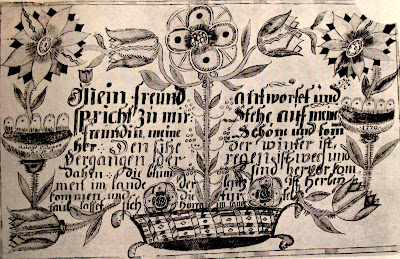
Thomas Merton illumines fraktur against "the blindness of 'single vision' which sees only the outward material surface of reality, not its inner spiritual form and the still more spiritual 'force' from which the form proceeds" (74). Shaker "work of the craftsman's hands had to be an embodiment of 'form.' The form had to be an expression of spiritual force. The force sprang directly from the mystery of God through Christ in the Believing artist" (79). The believing artist, given these forms in hand and mind by a spiritual force, God in Christ, would not find illumination outside these beliefs. Merton says Shaker art has "something to do with what Blake called '
the secret furniture of Jerusalem's chamber'" (74), that "a work-a-day bench, cupboard, or table might also and at the same time be furniture in and for heaven" (74). For Merton it is also obvious that "Shaker inspiration was communal...due not to the individual craftsman but to the community spirit and consciousness of the Believers" (76).
Anabaptists like the Shakers practice the communal production of their forms. Merton says Shaker forms were "a better, clearer, more comprehensible expression of their faith than their written theology" (76), which is what Stoudt says of Pennsylvania art, whose theology was a mythology seeing the outer surface through the inner form, the "spiritual force from which the form proceeds" (Merton, 74).
Merton, Shakers, Blake and fraktur celebrate
images of the natural fruition of paradise, a renewal of plant and animal that finds human life amid these images as a means of the flowering heart. Frakturs covered with lilies in the shape of a tulip,
images of a tulip blooming from a heart, roosters, flower-stars or any field or haystack transformed by the renewing mind, a spider, a fly, a rooster, child, cow, farmer, sky, grass endowed with plain dress by unplain people ornate in their inner lives, "their only advertisement was the work itself" (Merton, 79) in the field, orchard and plant. Spiritual conditions made out of the natural set Pennsylvanians apart. This celebration of life was much opposed to the surrounding English culture whose domination of peoples and empires had commercial motives.
Believing and Doing
Recapturing this Lily Age might be like trying to live out the prophecies of Blake, meditating mental archetypes, giant forms. But
the Lily has as much to do with the artifact as the Elohim have to do with the hex. Both are round. You can't get the Lily by running counterfeit. The Lily Age is not about nostalgia for a thing that once existed, stone pullers, horseback riders. You have to live it. Paradise is not an external state. It is interior, matching something unseen, mirrored in the seen, connected to an organic field, an image of the Kingdom of God, the ground out of which the Lily grows. Artifacts may be said to leave a trail of crumbs to show the external where it belongs.
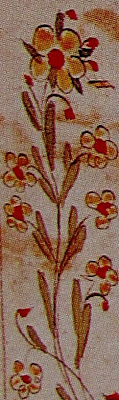
To this comparison of
fraktur and Shaker add Blake's relation of art and text. Blake's images, his decoration, languished in much the same way as fraktur text, divorced, when his work was neither reproduced nor understood. Even though Weiser says "
Fraktur existed for the sake of the texts," and "a few selected images to convey the message," nobody read those texts, much less took them seriously. Weiser says it was because of a "preoccupation with death and religious themes" (xxvii), but
such themes abound everywhere in English poetry, so why should it diminish the German? Separated from the text, fraktur decorations resemble Blake's art divorced from his writing. The visual image was accepted before the written.
If we could prove it was something esoteric it would get a following, but how can there be a vision in fraktur when it had multiple authors?
The vision is communal but not as esoteric among its practitioners as Blake among the scholars who spin a theory of imagination out of his evangel
Jerusalem. Until Erdman or Frye, critics were affronted at the idea of a coherent system in Blake. Their cousins among Pennsylvania critics are equally affronted at a hidden meaning of fraktur texts. Stoudt started to find it out, but his pietist peasants and Catholic saints got little support for
a hidden world in hymns. It affronted scholars also when he claimed a personal transcendentalism for thousands of Pennsylvanians a century before New England. Pennsylvania could have been credited had it come after, but coming before was not allowed. What is a personal transcendentalist?
You have the idea and live it instead of talk about it. It sounds like the Hopi elders.
Seeing life from inside out takes getting used to. It always seems impossible from the outside, which asks how it is possible even to be
immersed in a name, let alone to remain there. It is rather like that series of
embeddings that take place in many of the Psalms.
[Coming someday, a consideration of
German Literary Influences in the American Transcendentalists.]
Stoudt's Pennsylvania mystics ally with the Shakers. Thomas Merton's
Seeking Paradise: The Spirit of the Shakers (2003)
has a view of The Inner Experience. Merton's phrase "images of
Paradise" translates this art of making. It is about believing and
doing, "the peculiar grace of a Shaker chair is due to the fact that it
was made by someone capable of believing that an angel might come and
sit on it" (
Shakers, 85).
Such believing is a
stumbling block to visions among the critical classes, the prescient
Milton taking dictation of the Holy Spirit each night to compose
Paradise Lost,
the Shakers, who "believed their furniture was designed by angels--and
Blake believed his ideas for poems and engraving came from heavenly
spirits" (85). It is a great irony that Blake says his poem entitled
Milton was dictated to him (Ruthven, 63). A little of this frustrates a lot of rationalist.
The relation of Pennsylvanians to decoration of
tulips, hearts, stars and crowns, Mennonites turning flowers into
bookmarks to bring paradise indoors, linens, furniture and pottery of
communal tulips that grow from paper to linen and wood, letters that
whirl, signatures in spirals and stipples, a plain board, cap or or cup
of inner spiritual form from which the outer proceeds, greater
decoration the less.
K. K. Ruthven.
Critical Assumptions.
Frederick S. Weiser and Howell J. Heaney.
The Pennsylvania German Fraktur. Breingigsville: The Pennsylvania German Society, 1976.
Other links
Look here
and here
4. Fraktur is a Species of language Flower
Fraktur is
a species of language flower, but according to Weiser, "...one basic fact must be underscored in studying these documents--the illumination was auxiliary to the text" ("Piety and Protocol in Folk Art," 1). However, it can be shown that such illuminations emerge from the text. Consider Plate 60 of Hershey's
This Teaching, "
Ihr Kinder Wolt ihr Lieben," ("O Children Who Are Loving"). The design is attributed to schoolmaster Jacob Gottschall (1793), but the text, "O Children" is a hymn of Christopher Dock's, himself a schoolteacher. One intention of Pennsylvania Fraktur was to teach the alphabet to children, but here the letter strokes mimic the design of the flowers in the composition, making it a kind of
Calligrammes, a hand drawn
vispo, a flower of hand and mind. It was presented as a reward to a student, Anna Kampffer in 1793. We paint the drawing with words.
A vine, a "stem" of tulips germinates from a globe/seed in the right corner. This spreads up and to the left. Another bloom of this "plant," slightly unconnected and larger, blooms down from the top left as though rooted in air, coextensive, but separate from the vine. The second larger bloom mimics the colors and shapes of the capitals of the title, Ihr Kinder in rose, blue and gold stripes, as though the letters were flowers or the flowers letters.The upstroke of the blue I combines with the down stroke of the rose h, making three letters out of two, an elision designed. The larger blooms have smaller dark stems, unrooted, air borne. A current of air lifts the "letter petal" leaves, from right to left which "bloom" in two large four-chambered blossoms, penetrated by segments of the unattached vine. Through each center of the four chambers (circles) of the flower, covered by a cross hatched red and gold diamond, runs Hershey's "checkerboard."
so ubt was freude worth...
Erquicken Hertz und muth
[The practice of joy...
quickens hearts and minds.]
Several phonetic cognates sound like English.The immediate short lines and rhymes are felt in translation said aloud. The vine that springs from the seed at the lower right flows across the top of the page, which seed, translates as, "Be with us, on all our ways / Dear God with thy blessing." That is, the blessing rises in the vine. The title words
Ihr Kinder, underlined in gold, resemble the block style of Dock's fraktur. These intersect the center of the page and divide the text below from its flower above, as if a flower of the text rises from the word garden. Language flowers teach children to identify petal letters. The writing of the text below in thirteen long cursive lines, is identified in stanzas only by numerals 1 to 5, set in a hand so small the students must have known the hymn by heart.
A child art, the colors, floral designs intend to attract the eye. At least among Mennonites fraktur was child art, designed for children, sometimes executed by children with its colors and floral designs intended for the child's eye. Before we defame it as not high art we should remember our literary master William Blake and fear his reproving. The first study of it was by H. C. Mercer, "The Survival of the Medieval Art of Illuminated Writing Among Pennsylvania Germans." Proceedings of the American Philosophical Society 36 (1898): No. 156, 423-432.
That paradise accompanies the child is the point of paradise art, to decorate the new with hope. Pennyslvania German art is an art of paradise reckoned from
the child archetype. Fraktur
Vorschrift were given to school children as a reward for good performance. The teacher would make a flower as a bookmark or a watercolor according to ever more elaborate systems of ornament. Verses of the Bible turn the letters of words into flowers. The message was, "here is a picture of paradise." These days we give them greenbacks. Such symbols emerged from a life view that fostered them, that implied a millennium ready to lie down with the lion and lamb, now forsworn for Pop. Their notion of paradise fostered a fantastic idealism of decoration on linen, furniture, pottery, barns. They planted equally fantastic gardens if they moved to the city, covered their windowsills with violets. "We have heard how Christopher Dock prodded his pupils with such drawings. If he did not originate the practice, he is evidence that it was in use at an early date, for Dock wrote in 1750. These tiny scraps of paper with birds, tulips, other flowers and occasionally other subjects survive by the dozens" (Weiser, xx).
In the greater tradition it had wider applications. Most of this communal body was unsigned, but it was repeated again and again in images that migrated from paper to linen (show towels) to wood (decorated chests).
There are individual characteristics of fraktur artists. Dock uses block designs, initial capital letters filled with swirls and stipples, as Hershey puts it (59f ). He includes an alphabet and numbers in German and in English, with some scripture translated to English, a bilingualism that mostly ended with him. Sometimes he runs a banner through the illuminated title or above it. His students imitate these features, establishing a style which grows more ornate in later examples. Borders marked by whirls also under gird the initial letter in descending spirals, a common feature of Pennsylvania signatures.
Fraktur also occurs in baptismal certificates called
Taufschien, mostly printed, but the most notable are freehand
letters of reward and instruction,
vorschrift, given to children. Until Hershey's
Teaching (2003) there were few good reproductions. In a similar manner Blake's watercolors were hidden from
public eye, although inferior reproductions existed.
The essentially different genres of Taufschien and
vorschrift, which divide art from text mirror the divided demographics of the Pennsylvania German,. Ninety per cent were "churched" so called, that is, the Lutheran and Reformed
Taufschien. Ten per cent were Mennonite and Anabaptist
vorschrift. The "churched" assumed proprietary status over the whole by their majority status, but the social/political acts of Mennonites often outweighed them, which sibling rivalry impacts all discussion.
Free Library of Philadelphia’s digital collection of Fraktur.
5. The Way Into the Flowering Heart II. A Revelation of Interior Presence
A Revelation of Interior Presence
Hymns and folk art transmit the tale of this
inwendigkeit* of two great proponents, Jacob Boehme (1575-1624) and Johann Arndt (1555-1621). Boehme's Lily Age studied its cultivation. The basics of such thought show symbols on pottery, tools, chests and linens to be a revelation of interior presence. What God had to do with materiality was a crucial question. Boehme said creation revealed itself to itself, "inward illumination was the only basis for spiritual growth." He celebrated internal absolution, inward Baptism and inner union with the divine, and identified
entirely different languages of these worlds. Robert Bly cites him in
Light Around the Body, "for according to the outward man, we are in this world, and according to the inward man, we are in the inward world....Since then we are generated out of both worlds, we speak in two languages, and we must be understood also by two languages." Bly cites the same lines in
The Insanity of Empire (13), but these two languages are in doubt for there is
no inner language of thought. Thinking so is another cause of
the blindness Bly preoccupies (Part IV). Thought is the overheard voice.
*takes the inauthenticity and blindness of the contemporary unreflective mode of existence and appeals to a turning inward, a cultivation of the depths of subjectivity in an effort to gain a superior concept of experience. (Walter Benjamin. An Aesthetic of Redemption.)
The
inner life got both occult and the mundane dismissals. Pennsylvania German elite defended their ideas by saying,
"we are a little slow, and perhaps too conservative to be very brilliant." Robert Bly presumes to describe his better, Wallace Stevens, and his Pennsylvania German family as "upper middle-class German Americans [who] appear to be successful repressors of the dark side" (
A Little Book on the Human Shadow, 66). Bly received supports and grants for such criticism. He was made the darling, Stevens however did not resist the flower. When his sister told him their grandparents were "not Pennsylvania Dutch, but...born in Germany," he said, "I am not prepared to accept my sister's statement that my mother's grandparents were born in Germany...I don't know that my mother ever really said it and, if she said any such thing, she could only have said it on the basis of something told her by her mother" (
Letters, 416). Presumably this means he thought they were born in Pennsylvania and were "Dutch." What that is of course begins the telling of many tales which at base are of the flowering heart. Stevens argues the hearsay of generations by splitting High German and Pennsylvania Dutch: "My mother's father, John Zeller, was born in Berks County on October 21, 1809," and "my mother spoke Pennsylvania Dutch." This ancestry appears in the blood of his poems from "Complacencies of the Peignoir" of Sunday mornings to his "weekends...potting things up and bringing them indoors so that the room in which I sit in the evenings now looks like a begonia farm. I have other plants upstairs and down and all over the place" (
Letters, 473-4). Have a look at
Wallace Stevens, Naturalist in this regard and
Wallace Stevens and The Bed of Old John Zeller and then at his
late in life baptism that was squelched by the establishment that it contradicted. Bly might approve a Sufi dance, but no baptism except the
pagan ministers who baptize the wind, which is what happened to flowering heart, it 2-ply, 4-ply doubled and blew up in the world until everybody thought they'd gotten one. But we came to wonder at the naivete in believing that
the bursting stalk above the eyes takes root into the brain and waves the life of the waving world into the heart again. That's not what happened, not what was meant at all. To the contrary,
we lost a third part of the atmosphere (
Banquet of God).
 Mundane critics
 such as Bird, Wentz and Weiser force reason against this emotive heart. Bird quotes Weiser that "highly religious texts cannot be taken at face value as if every Dutchmen (
sic) spent his life on his knees" (
O Noble Heart, 20). Of the higher order of Dutchman Robert Bly says Stevens "followed a pattern that has since become familiar among American artists: he brings the shadow into his art, but makes no changes in the way he lives" (
Shadow, 77). You think Bly changed in
the flash, in the twinkling of eye? This however is the same Stevens who said that if "we should meet a monsieur who told us that he was from another world, and if he had in fact all the indicia of divinity, the luminous body, the nimbus, the heraldic stigmata, we should recognize him as above the level of nature but not as above the level of the imagination" (
The Necessary Angel, 74). Such words and worlds transform.
Facetious asides such as Weiser's about Dutchmen on their knees communicate the English grievance against the Germans, that they were uneducated boors, but really they were visionary transcendentalists a century (1730) before New England. Pennsylvanians reveled in their peasantry even while faulting themselves for lacking education, but the difference between Pennsylvania and Massachusetts in belief and education is
guilt. The puritan second and third generations were consumed with it (Perry Miller,
Errand Into the Wilderness, 15). If the flowering heart and its sanctified natural presence were denatured by this later malaise, Anabaptists had long before shunned
public celebration of the inner word world. When
disbelief became an epidemic among their critics the exfoliations on quilts, chests and hearts stopped, struck down as absurd as
The way into the flowering heart
inside the flowering man
is over the inside itself,
inside the new found land.
In this unique view of natural vegetative man celebrating a flower, the Pennsylvania Dutch were
inherent environmentalists of the first order. But Pennsylvania transcendentalism was ignored.
Thoreau is credited with founding the wilderness movement in his "Huckleberries" (1862) and "Walking" (1851), from which a Puritan Origin of the American wilderness movement is extrapolated. Nonsense. This is like saying The Taliban Started the Free Speech Movement. Such misdirection is all dragged from a phrase in Thomas Morton's
New English Canaan (1637), "nature's masterpiece," and from
unpublished notes of Edwards in the "beauty of the world," more worship at the English chapel as the source of American culture. Puritans saw nature as a "vast and howling wilderness" in that bully phrase borrowed from Deuteronomy, but see
How American Sounded here or The Columbia Guide to American Environmental History here. In
Jonathan Edwards' three pages in the back of Miller's edition of 1948,
The Beauty of the World (unknown until 1948), "images of divine things in the beauty of the world" make the corporeal resemble the spiritual. Bodies and nature reflect, as in Psalm 19, the planets and sun. The "complicated proportion" of green, white and blue are like the relation of sight, sound and smell which "vibrate" the human organs. These "mutual consents," are resemblances, influences of "lily," waves, woods, plants, flowers and light upon the "holy virtuous soul." So
"the more complex a beauty is, the more hidden is it." One "loves life for its natural and reflective resonances of the greater." In this "consists principally the beauty of the world." The manuscript however, in the back of Perry Miller's edition, was unpublished.
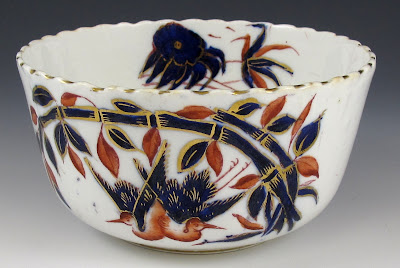
Transcendentalism proposes to creation that it reflect the divine. Once every hundred years, English advocates claim it: Morton, in 1650, Edwards, in 1750, Thoreau, Emerson, in 1850, as founders of English Environmentalism. But
“the full blown rose of mystical transcendentalism blossomed in Pennsylvania a full century before New England’s scrawny plant began to bud” (Stoudt, 1966, p. xix)." Scholarship is often merely sleight of hand. Pennsylvanians were transcendentalists
en masse a hundred years before the nineteenth century movement in New England:
"An awareness of German culture was a recent development in New England when the Transcendental movement began. Unlike New York and Pennsylvania, where large numbers of immigrants from Central Europe had settled in the eighteenth century and German traditions were well known, in New England few could read German until the early nineteenth century. Translations of German literature were not generally available, and uninformed opinions of German culture were largely negative. In the second half of the nineteenth century however the situation began to change...." Howard E. Smither (A History of the Oratorio: The Oratorio in the Nineteenth and Twentieth Centuries. Chapel Hill: University of North Carolina, 1979, IV, 430).
Vogel's
German Literary Influences, but not much else seems to have appeared to illumine the hundred years of Pennsylvania transcendentalism before New England. If we are serious about the transmission of transcendentalism from Boehme to the Puritans we cannot bypass the Germans in Pennsylvania who had long before taken him up, stitched him into their quilts, which involves also the translation of William Law and the illustrations that Dionysus Freher reproduced in the four volume Boehme English translation.
Considerations of the mystical Pennsylvanians include
:
The true practice of conflict in the eighteenth century, from Beissel to Sauer, was inward, but outwardly measured or expressed.
If we are hindered in the natural by societal measures of the Pennsylvania German there is also hindrance in the supernatural by philosophical mysticisms.
Everything depends on the right search term:
Puritan Wilderness.
Consider that these are all in quotes:
"Only the most habitually critical students are likely to get what you're talking about when you suggest to them that "wilderness" is not a name like "mountain" or "river" that refers to common features of nature, but a lens through which nature is perceived. Wilderness is, in short, a "socially constructed" idea. Your job is to help them deconstruct it." Second level voyeurs undress, find sss....
This analysis by
J. Baird Callicott, Priscilla Solis Ybarra mistakes the part for the whole, the puritan interpretation of wilderness for the biblical one, but so does their source, Roderick Nash.
Wilderness and the American Mind (1967/1982), "that wilderness is an important biblical theme, the "antipode," on the spectrum of good, bad, and indifferent places, to the paradisaical Garden of Eden.
It would be much more to the point to say these were biblical
interpretations. These scholars derive the conservation movement from the puritan's "
vast and roaring wilderness" and William Bradford's
"hideous and desolate wilderness full of wild beasts and wild men," the opposite of the case. There is disregard of the Beauty of the Way in already century old puritan philosophy.
Conclusion
 |
| Looking For Work |
The imagination is the difference between the mind and the hands. The trail to the interior
translates language, dimension, memory and sense.
This figure, Looking For Work, pretends that those who walk there have had their tongues
cleansed. That's why his back is turned. Maimonides says the imagination needs to be sanctified, that
idols,
Dereviannye idoly, set up in the contrasts of
language enacting literature make the mind of this people dull, stop their ears and shut their eyes. The house must be occupied or vagrants and strangers will move in with vandalism, dumping, teenagers, gangs.
To prevent unclean spirits it is not necessary to sweep clean and put in order; it is necessary to occupy. Vacancy is an omission whose overthrow is a commission, as the Lindisfarne Gospel (950 A.D.) says,
"alla woepeno his zenimeth. . .& reafo his todaelde" (OED). Reafo his todaelde means “plunder his entire house” (Luke 11.22) and thereby set in order.
With this sanctifying and cleansing,
hands begin, mind shapes, brain directs angle and line. How is sanctified light found? This does not require consciousness.
Imagination can make a bird, a plant, a tree without it. Idols manufacture imitations all the time unrelated to what imagination seeks. Language is like marble. Sculptor Michelangelo looks into marble to see David. Words are more difficult.
A seraph brings a coal to Homer, the Aeneid, Chinese mountain snow, David's meditations, Satchmo. Imagination translates the great that extends beyond sight. Will must speed faith in praising. How talk to the outer world from the inner when there is
no language of thought? Thought made into language assumes it speaks what it thinks, but thought is not languaged. That this occurs after translation is a glaring assumption. The medium of thought is image. Efforts to track this, as perhaps Bach in his
Voices of the Turtledoves (2003), devoutly read German sources into English, but neither German nor English bespeak the inner world.
When we see inside something we think it remarkable, as if this were
the spirit of the thing. The spirit differs from a literal, say in song, where it sings the spirit of the song, not literally perform the music and words. This breaks the expectation of the literal that surrounds the interpretation of the song. There is no literal score to poetry. It directly speaks the spirit.
Since translation of thought to language is like a performance, a prosody that departs from expected diction and line is prima facie of spirit, but never had a literal version against which to test itself. This is one step closer to the Original, but still not the Original. What Mahalia Jackson sings as the spirit of the song
Just a Closer Walk is closer to the experience of the words than the words. This shows the difference of the inside and outside. Louis Armstrong said this song gave The Beatles
Let It Be. The Japanese word,
kotodama, celebrated by Barry Lopez in his acceptance speech for the National Book Award for
Arctic Dreams, signifies that
each word has a spiritual interior.

Bible is here continually equivocated for Puritan. According to Nash, the Bible consistently characterizes wilderness as "cursed" land, "the environment of evil," a "kind of hell" on earth. "The Puritan settlers of New England, steeped in the Old Testament biblical worldview, believed they found themselves in such a "wilderness condition" of continental proportions. It was their God-ordained destiny to transform the dismal American wilderness into an earthly paradise, governed according to the Word of God.... "
Callicott and Ybarra say: to hear Nash tell it,
"seventeenth century [Puritan] writing is permeated with the idea of wild country as the environment of evil." Certainly one finds Puritan fear and loathing of wilderness in William Bradford's
Of Plymouth Plantation, 1620-1647, and many other seventeenth-century Puritan writings, such as Michael Wigglesworth's
God's Controversy with New England (1662), and Cotton Mather's
Decennium Luctuosum: An History of Remarkable Occurrences in the Long War Which New-England Hath Had with the Indian Salvages (1699). While it would be an exaggeration to claim that a celebration of the American wilderness and its indigenous peoples could be found in Thomas Morton's
New English Canaan (1637), one does find there a much more sympathetic portrayal than in its contemporaries."
"Thoreau
here opposes Nature to civilization, wildness to culture, and himself to his pious audience. Thoreau, a close associate of Ralph Waldo Emerson is, like Emerson, labelled a Transcendentalist. It's not entirely clear what Transcendentalism was—elements of Platonism, Hinduism, Romanticism, Deism blended together—but it seems pretty clear that it was a far cry from Puritanism.
"This idea that
wilderness is a human constuct is all of 15 years old, "the romantic sublime, imported largely from Europe, coupled with a more homegrown celebration of the American Frontier as a domain of individualism."
***
The essence of the flowering heart, in the words of Michael S. Bird, is that "the world of natural and even humanly constructed beauty is never pronounced evil (21). His justification for saying so is that this "would hardly be consistent with the biblical account of creation and the making of 'a world and its things' deemed to be good."
End note

The divisions of in and out, like energy and matter, male and female, mind and body, earth and heaven, activity and rest, age and youth, viewed as opposites, justify all the worst attitudes seen in the separatists where behaviors, dresses, fashions were ruled in or out. These go from hook and eye vs. buttons and zippers to velcro politics, gender, ethnicity, celibacy and tantrism, all politics. In Pennsylvania Dutch imagination a decorative principle becomes an aesthetic of life.
6. Good Friday Riding Westward. Leaf Meditation of the Inself Border
Good Friday Riding Westward. Leaf Meditation of the Inself Borde
We cannot deny the inself in three dimensions even if it
lives in four. The truest representation is sculpted. A scientist
claims to the artist, "you made the leaf, but I discovered it," but the
sculptor replies, "you made it too, described it, plucked it, preserved
it in glue. It is a construct of your mind and mine." But neither
of them did. Neither travel to that far country from which when you
return you cannot speak and if you did no one would believe.
Can word be both text and the image, graffiti over-top? The image
cries out to the Branch to be spoken. Word longs to be seen.
Fraktur text and image twine. Concrete poems,
vispo pretend paper and type. Blake
illustrates.
We must know the leaf
inself alive. The botanist who presses a leaf must know the leaf alive, but image and word are incompatible.
The Cover
This is all Levinas before I knew him.
Walking one side of this border, up against it, cross immediately the other side.
The Speech of Corn
Twine a poem about a branch,
it will not leaf.
Tendrils do not speak.
The
Inself speaks the plant.
What is the speech of corn?
What says aloe? Every thing has breath. Plants breathe light
. THOSE WHO LOOK TO HIM ARE RADIANT. I will consider in my dwelling place like a clear heat upon herbs, a cloud of dew in the midst of harvest.
At
Altamira
many millennia of horses and bulls had no words, but rhythm and color. They had no language, nothing written the stones cry.
Breuil says art was an extension of hunt, the worship of life, a celebration.
These matter when the content is
greater than itself. The words show something more than mundane. Why
else make the effort? Charles Williams designs the figure of a woman and stretches it
over the kingdom of Logres, over all of Europe (see the endpapers of
Taliessin Through Logres,
Oxford, 1938), like the Cave at Altamira and its bison, except
Williams' Europe is Logres, Arthur's kingdom, and did not
exist as the bison in the real, or it did and now only remains expressed on the cave
wall, as the bison, Williams' Taliesin.
Inself sounds like Inscape. A
true statement about Hopkins is that "seen from one point of view
Hopkins' work is some dozen nearly perfect lyrics. Seen from another
perspective it is a heterogeneous collection of documents...but within
this seemingly chaotic mass we can detect a certain persistent
structure." J. Hillis Miller. This describes life on the borders.
Take the border between image and word.
The verbal is the interior leaf,
images the internal sense,
the leaf inself of the seen,
the leaf inseen of the self.
7. Images of Paradise of the Pennsylvania Germans: Antidote to the Fall


In the end these images must be simplest, a linen cloth, plain dress, apron, wood bench, a paradise of the everyday that is real, so most of high color, ornate rhythmed fraktur is not indigenous.The short list of ornate is obvious, "tulips and hearts and stars and crowns and angels from peasant art, unicorns from the British arms and eagles from American heraldry" from "birth certificate to tombstone" (Weiser, xv). Hershey says "the predominant designs are taken from nature," with the exception of "the angel and heart motif," "more variations than one person could imagine, as well as birds of all feather and fancy" (52). The chief artists were children and teachers of children, parochial schoolmasters, Mennonites. Mennonite Christopher Dock began the traceable fraktur tradition along the Skippack in Montgomery County as
This Teaching I Present: Fraktur from the Skippack and Salford Mennonite Meetinghouse Schools, 1747-1836, attests.They say the full flowering of this art ended in the mid 1830's when Pennsylvania decreed its public school system superseding religious instruction, but that is the difference between art and life. Paradise of simple lives on.
Fraktur
Vorschrift were given to school children to reward good performance: you have done well, here is a picture of paradise. "We have heard how Christopher Dock prodded his pupils with such drawings. If he did not originate the practice, he is evidence that it was in use at an early date, for Dock wrote in 1750. These tiny scraps of paper with birds, tulips, other flowers and occasionally other subjects survive by the dozens" (Weiser, xx).
In the greater tradition it had wider applications. It begs the question of individuality because little of this body was signed. It was communal, repeated again and again in images that migrated from paper to linen (show towels) to wood (decorated chests).
There are individual characteristics in various fraktur artists. Dock's are characterized by blocked designs, initial capital letters filled with swirls and stipples, as Hershey puts it (59f ). He includes an alphabet and numbers, in German and in English, with some scripture translated to English, bilingualism that mostly ended with him. Sometimes he runs a banner through the illuminated title or above it. His students imitate these features, establishing this style which is not as ornate as later examples. Borders are marked by whirls which also under gird the initial letter in descending spirals, another feature of Pennsylvania German signatures.
Blake's Illuminations
Images of birds, flowers, angels, crowns from "a prototype in the mother country" (Weiser xxvii) beg comparison with Blake's illuminations whose "decorations" also suffered in obscurity because they were neither adequately reproduced nor understood from his private system of vision. Any similar rejection of the relation of art and text stands out. Weiser says no matter what their beauty of illustration that "
Fraktur existed for the sake of the texts" (xxvii), an especially Protestant dependence "on the text and a few selected images to convey the message," (xxviii) hidden from understanding because of a "preoccupation with death and religious themes." You sense here a defensiveness in the critic, such themes are omnipresent in English poetry. The decorations of fraktur have been treated as an end in themselves much as Blake's poetry had been elevated above its images. Fraktur
texts are now ignored as much as his illuminations were.
Multiple fraktur had multiple authors, but critics cannot find a system of thought in fraktur texts or have not stepped back far enough to see it. Blake's system was not perceived as a unity comprehended in his visions. It is still difficult for critics to affirm the literal Jesus found everywhere in
Jerusalem and not make the reference over into a theory of imagination cut off from the literal. Until Erdman or Frye, critics were affronted at system in Blake. How could the critical cousins swallow then an esoteric unity in fraktur texts? Stoudt started out to find such, but the discredited world view of pietists allowed little credence to the notion of a world in hymns of verse. Opponents argue that multiple authorship from disparate sources further prevents this, but any point about a unity of texts depends anyway on a communal not individual expression of unity, on Pennsylvania Germans manifesting personal transcendentalism maybe, and a celebration of nature in their hymns and art well in advance of the birth of these ideas in New England. [Coming here, consideration of
German Literary Influences in the American Transcendentalists.]
So what if Pennsylvania Dutch art is a product of "a spirit of mirth, of play...a love of beauty and a fantastic impulse to embellish" , painted furniture, carved wood, Christmas cookies cut "in hundreds of designs," inlays, embroideries with "the play and glee that only a man at peace with life can relish" (Frederick S. Weiser in
The Pennsylvania German Fraktur of The Free Library of Philadelphia, 1976), xv)? The man of peace was at war with his divided self? The man of peace at war may be the genius of his muse.
Shaker Analogy
Images of Paradise imply a heavenly art translated to earth, as among the Shakers where "the peculiar grace of a Shaker chair is due to the fact that it was made by someone capable of believing that an angel might come and sit on it" (Thomas Merton, 85). The key is "
capable of believing," prescient Milton taking dictation from the Holy Spirit to write
Paradise Lost, or as Merton says, "Shakers believed their furniture was designed by angels--and Blake believed his ideas for poems and engraving came from heavenly spirits" (85). Merton likens the Shakers to Blake's protests "at the blindness of 'single vision' which saw only the outward and material surface of reality, not its inner and spiritual 'form and the still more spiritual 'force' from which the form proceeds" (74).
Merton's Shaker approaches the Pennsylvania Dutch mind: "the work of the craftsman's hands had to be an embodiment of 'form.' The form had to be an expression of spiritual force. The force sprang directly from the mystery of God through Christ in
the Believing artist" (79). Merton says Shaker art has "something to do with what Blake called 'the secret furniture of Jerusalem's chamber'" (74), that "a work-a-day bench, cupboard, or table might also and at the same time be furniture in and for heaven" (74). It is obvious for Merton that "Shaker inspiration was communal...due not to the individual craftsman but to the community spirit and consciousness of the Believers" (76). Indeed that the Shaker forms were "a better, clearer, more comprehensible expression of their faith than their written theology" (76). This mythology sees the outward material surface through an inner spiritual form and still more the "spiritual force from which the form proceeds" (74).
Renewing Mind
So we make the case that Pennsylvania Dutch images of paradise celebrate the natural fruition and birth of plant and animal, find for the human a place amid these images, called here the way into the flowering heart, frakturs covered with lilies in the shape of a tulip, images of a tulip blooming from a heart, a rooster as a celebration, a flower-star and any field or haystack transformed by this renewing mind. The spider, the fly, the rooster, the child, and why not the cow, the farmer, the sky, the grass show plain dressed and unplain people, Gothic or not, ornate in their inner lives, "their only advertisement was the work itself" (Merton, 79), field, orchard and plant. Dutch celebration of life was by all means opposed to the surrounding English cultures whose domination of peoples and empires were commercial enterprises. Spiritual conditions made out of the natural set Pennsylvanians apart.
Recapturing the Lily Age might be like trying to live out the prophecies of Blake. It is all inside the mind's archetypes, giant forms to meditate. The Lily has as much to do with artifact as the seraphim with the hex. Nothing. Both are round. You can't get to the Lily by turning it into a counterfeit. It is not about nostalgia however for a thing that once existed, for stone pullers, horseback riders. A proper understanding of paradise requires the concession that it is not an external state. Paradise is interior, matching something we can't see, mirrored in what we can, connected to an organic field called the Kingdom of God, meaning the ground out of which the Lily grows which is completely within. Field, sky, sun and lovely plant in this world proceed on vegetative time,
as a tree planted by rivers of water. Artifacts may be said to leave a trail of crumbs for the external mind , give it an illusion that it belongs. A pewter pitcher of nineteen hundred may be a clue.
Dominant English culture however saw nature as a mine, an exploitation, but the lily age celebrated nature for itself in behalf of Christ, a different kind of utility, as though legislating protection for the whale because God loves it. Were the salvation of nature so desired this might be forgiven by secularists. The Pennsylvania Dutch paradigm of the conservation of the biosphere is actual. It was once thought that the first principle of creative art and life among these peculiar people was "the divining of nature" which resembled the beating of swords into plough shares as a shorthand of that paradigm. "Peculiar" is a compliment connoting unworldly, uncommercial. Substitute the sword with the plow, commercial exploitation with conservation, and electric companies will be decommissioning dams to restore riparian habitat (Fossil Creek, AZ) when earth enters its final age of peace.
It is not too hard to accept the Pennsylvanians as an antidote to the destruction of nature, treasuring it so within to foster the underpinnings of a more caring world against the outer one that transforms everything to itself. The irony upon the elegant is that liberation comes from a people Franklin called brutish, who rejected the outer ethic of exploitation and "original sin" of slavery that is now the stuff of presidents. Commissions of an even greater original sin than slavery rebound along demolished salmon coasts in the demolition of buffalo and prairie, a sin against nature as old as Cotton Mather's infection of new worlds
New England vs. Pennsylvania
Afterword - Did You Find Paradise Today?
Told it doesn't exist you long for paradise. When it was in the interest of scholars they believed,
not that they personally thought it existed or its art in the mountain sunset or the mouse. Were paradise free speech or whatever pleases, the three harvests and hot tubs of the captives of pleasure could have private paradises too. But the art of paradise is not about us, it's about the creatures that inhabit it, wild or domesticated
in a green Shade. Paradise kept with hands brings the natural to the human.
Free of the separation which we reckon occurred when the serpent came to America, myth before discovery, besieged by enemies in a colonial fantasy of sexism and racism so called,
thinking makes it so. Serpents destroy forests, prairies and animals, take dystopia over utopia, symbols of destruction over innocence. It's hard to imagine paradise in an age that denies it but longs for memories of wholeness it forgot. Was there peace? Nobody wants Inferno, but nothing succors in the deconstruct.
We get over disbelief. The child believes, but the adolescent diminishes, imitates the adult. In their private paradise they go to pillage the garden. Ask if one believes and get a look. One believes in profit. One believes in success. But look for paradise if you believe it's lost. Find a piece of paradise. Evening conversations would begin, "did you find paradise today?" Everyone would be looking.
This fictive assumption presumes a restoration of earth was forming in the minds of artists with the industrial revolution, the chimney sweep of Blake, that
paralysis immobilized agencies able to effect remediation. In reinvention, but the paralysis is also metaphorical, we rise in the night, thoughts start before four AM. So would creation travail with the problem sons. You could wish they were out of the way, but not if worse were in store. We may go on with daily life, right to the end,
shibboleths of the past argue, as though they meant something. Doctrines of false imagination finish the day, sleep another night in evasion and deny.
8. Man of Peace Wars with the Divided Self
Substitute the sword with the plow, commercial exploitation with conservation, and electric companies will be decommissioning dams to restore riparian habitat (
Fossil Creek, AZ) when earth enters its final age of peace. The lily age of the German peaceniks celebrated nature for itself on behalf of Christ, which today might mean legislating protection for the whale because God loves it, a Pennsylvania Dutch conservation of the biosphere.
It was once thought that the first principle of creative art and life among these peculiar people was "the divining of nature" (Stoudt). To a beating of swords (words) into plowshares as a shorthand of that paradigm, "peculiar" is a compliment connoting unworldly, uncommercial.
The Pennsylvanian antidote to the destruction of nature fostered the underpinnings of a more caring world against the outer division that transformed everything to itself. This liberation came from a people Franklin called brutish, inelegant, who rejected the outer ethic of exploitation and "original sin" of slavery now corrected by presidents. But commissions of
an even greater sin than slavery along salmon coasts and prairie were
a sin against nature as old as Cotton Mather's infection of new worlds.
So if Pennsylvania Dutch art is a product of "a spirit of mirth, of play...a love of beauty and a fantastic impulse to embellish" painted furniture, carved wood, or Christmas cookies cut "in hundreds of designs," or embroideries of "glee that only a man at peace with life can relish" (Weiser, xv), we say that
the man of peace was at war with the divided self imaged in alienation from nature. The man of peace at war may be the genius of his muse.
Eighteenth century English-American culture saw nature as a mine for exploitation in spite of the phrase in the Declaration of "the Laws of Nature and of Nature's God." Two views of paradise and wilderness occupy the outward surface of this that beg to be called by analogy, a corn field resurrection. In this the literal is made symbolic as such transformations in Van Gogh's fields and sky. Alternate realities come to pass as different poets touch paradise. Blake in
Songs, Roethke,
The Far Field, slightly demented, Lawrence,
Birds, Beasts and Flowers (1923), T. H. White,
The Book of Merlyn, Ted Hughes, Barry Lopez, Aesop celebrate the inhabitants who are not ourselves. Lopez in
Lessons from the Wolverine, and in
Field Notes, empathizes with the living animal and in
Apologia with the dead. T. H. White's instructions of the animals to Arthur in Merlyn are a further extension from his translation of the 12th century bestiary,
The Book of Beasts.
These are some of the texts that counter the English-American domination of nature. These take as a premise that to name a thing you must meditate it like St. Francis, naming it from within. Naming the animals is not what a government biologist does in thinning wild horse herds and elk to protect cattle, imposing a false, human order on the real. This idea masquerades
human good as a care of the wild. Preconditions of wilderness itself require thoughts free of such prejudice and commercial greed. The Pennsylvanians had their own image myths of the natural to accompany
the archetype of the child, viz. paradise, much as the mobile above the crib, the doll and the stuffed animal accompany the child. You can see them in the
Show towel decorations of
This is the Way I Pass My Time. Ellen J. Gehret
.
The Pennsylvania-German Decorated Chest. Monroe H. Fabian.
This Teaching I Present: Fraktur from the Skippack and Salford Mennonite Meetinghouse Schools. Mary Jane Lederach Hershey.
Fraktur Writings and Folk Art Drawings of the Schwenkfelder Library Collection. Dennis K.
Moyer.
Paradise and wilderness are mutuals not opposites. Glimpses of these ideas in American Indian notions of natural relation are unbelievably also present in Pennsylvania Dutch art, which include: "tulips and hearts and stars and crowns and angels from peasant art, unicorns from the British arms and eagles from American heraldry" from "birth certificate to tombstone" (Weiser, xv). Hershey says "the predominant designs are taken from nature," with the exception of "the angel and heart motif," and "more variations than one person could imagine, as well as birds of all feather and fancy" (52).
The artists of these were first children and teachers of children, parochial schoolmasters and Mennonites. Christopher Dock began the traceable fraktur tradition in Montgomery County PA.
This Teaching I Present: Fraktur from the Skippack and Salford Mennonite Meetinghouse Schools, 1747-1836, says it was "along the Skippack." The full flowering of the art declined after the mid 1830's when a PA public school system began to supersede religious instruction, but this was not the sole means of decline. But in this world it is more customary to speak of the decline than of the flowering.
The man of peace at war with this is against its commerce, hence he will in no way be heard. That doesn't matter. He is part of the Resistance that has been fought from Genesis. We were privileged to trade the mess of American exceptionalism to live
among the river sallows, borne aloft or sinking as the light wind lives or dies.
Works Cited
Mary Jane Lederach Hershey.
This Teaching I Present: Fraktur from the Skippack and Salford Mennonite Meetinghouse Schools, 1747-1836. Intercourse, PA: Good Books 2003.
John Joseph Stoudt.
Pennsylvania German Folk Art. Allentown, PA: Pennsylvania German Folklore Society. 1966
Frederick S. Weiser and Howell J. Heaney.
The Pennsylvania German Fraktur. Breingigsville: The Pennsylvania German Society, 1976.
Richard E. Wentz. Editor,
Pennsylvania Dutch Folk Spirituality. Sources of American Spirituality Series. New York: Paulist Press, 1993]
Don Yoder.
Discovering American Folklife. Mechanicsburg: Stackpole Books. 2001
Hex Signs (with Thomas E. Graves) Mechanicsburg, PA: Stackpole Books, 2000.
Pennsylvania Spirituals. Lancaster, PA: Pennsylvania Folklife Society, 1961
9. The Way into the Flowering Heart in Blake
Milton descended into Blake's left foot! (Davis, 105). Blake wrote of the psychological dimensions of the fall of Adam that he allegorized to the thought of Boehme.
These angels Blake saw, think of them as flying nudes. He saw them in trees and shrubbery as a child, couldn't be convinced otherwise. Now he is famous for his
doors of perception of druggies armed with mescaline, but he lived without drugs, completely determined to live in this world while in that other. Blake invented the doors of perception Aldous Huxley tried to enter at his death with mescaline. The list is long of those who seek these doors. Just take a little yage! But for Blake the doors were open all the time to the flowering heart. They were open for Milton and for Donne no doubt, who never said a word about perception. The Hebrew poets were singing of it while the Babylonians were getting high in West Virginia, "going out and coming in from this day forth and even for ever more."
Plain as any Mennonite, Blake took his denomination of being seriously, would be labeled a dissenter and sectarian if any group fit. There are none. Efforts to degrade him into known categories and paradigms don't work, past or present. He is no more a tantracist than a mescaline user.To think he speaks for any other party is to reduce him to the commonplace as is done when Coleridge's pipe is celebrated more than
his mountain climb (see Macfarlane,
Mountains of the Mind, 81-84).
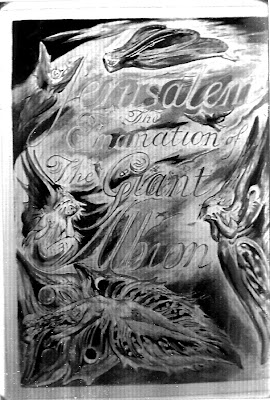
Lately they try to divorce Blake's wife from him, who was especially devoted to him, in effort to put them asunder and have Blake for themselves.Critics need
pepper to blind the eye so no one can see the fraud they perpetuate. This peppery criticism makes for instant reputation. Another problem, Blake is a Christian.
There has been a revolution of the tools of thought and access to Blake's life. Thus the incomprehensibility of books about him begins to pass. Most of these are written in the complex sentences of scholars in apposition. Now, if you sit down in a chair before the Princeton Editions or the Blake Archives and look at the pictures, you pretty quick understand Blake's religion is the simple, complicated, ecstatic, nonconformist, charismatic, prophetic, biblical kind. Art is his gospel fruit and he turns theosophy on its head. He says God is man, not man is God.
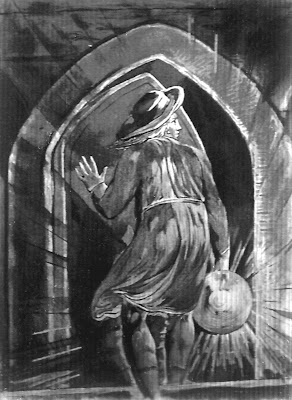
Read in context with the contemporary George Whitfield he agrees with nothing and everything. Critics once tried to enter his life through his work, but it is easy to enter his work through his life. In the end if he says some mad thing, which he will do, his life proves his work serious, discipline proves him sound. In his own time his "pleasing, mild disposition" was said to be the only thing that kept him from being put in an institution. Mad poets, now celebrated, threatened conformity. He is still being made over. His mind must be ruled to save him from himself! Such notions always overwhelm martyr and visionary. Monastics, Moravians, Mennonites, Quakers, Dunkers are ready to sacrifice the outer world for the in.
Blake Is A Christian
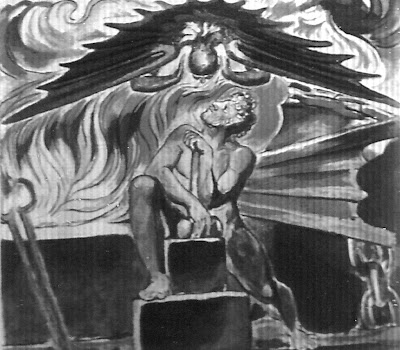
Blake's life confronts the inner/outer world. From
Pilgrim's Progress, melancholy poems about
The Grave, Michelangelo's notion of creation, Milton's ditto and on, it's folly not to see Blake in the center of this context, with his own take on every Biblical idea of outer versus inner, world versus spirit. "Free yourself from the world," says also
Chuang Tzu.The experience of the spirit world, especially the biblical part of it libeled as hopeless fundamentalism in prophecies of "end times" is not what it seems. One sentence from Yeats is better than whole books. Even spiritualized as Yeats is when he says that for Blake "Christ was his symbolic name for the imagination" (xvii), this partial truth is better than whole lies from the moths of instruction. So when Yeats seems to have his way with finding and losing his life, he makes a greater statement. He says that Blake "came to look upon poetry and art as a language for the utterance of conceptions, which, however beautiful, were none the less thought out more for their visionary truth than for their beauty. The change made him a greater poet and a greater artist; for 'He that findeth his life shall lose it, and he that loseth his life for My sake shall find it'" (xvii). Surveyed with an open eye only the hugest figures have celebrated that Name above every name that Yeats names.
Myrrh
Blake as a Christian is a stumbling block, but so is his marriage to and love of Kate. He would understand that myrrh drips from the handles of the lock. Who among the poets had a wife who sustained a lifelong relation of devotion, who not only took care and gave life and continuity to the poet, but who did his work, his printing and who was his sole model and consort? This dream eluded Yeats. Blake and Catharine used to take 40 mile walks together in the countryside. Aesthetes say Catharine got old and Blake was threadbare and dirty. He was a printer. They lived spare, were not thought to be the people they were. Not worldly at all. Is there one other who had his riches? Emily Dickinson. Kate was his sole model and consort! She was beautiful. Whatever you think Blake was about it hugely concerned the sensual, the sexual, the female in the same way this preoccupied Joyce. Whatever it is we're after in the life of Blake takes to task in us our essential eroticism and identity. Yeats deeply desired in a companion what Blake had, so he would know its value when he says that with Kate, Blake had a "love that knew no limit and a friendship that knew no flaw" (xx).

2.
Burn the Dross
Great oddities occur after Blake is dead. Frederick Tatham disposed of his poetic estate, burned piles of things, but everybody else has had their day with the
objectionable. Blake himself burned a lot of dross. The same flame draws the Many Moth (critics). In some ways Blake was better off in obscurity. Moths obscure the light of his work with tantric, alchemic occultisms. The sensational critical environment is so extreme that Yeats hits a kind of center when he says that Blake displays a profound sanity because he never "pronounced himself to be chosen and set apart alone among men" (xii), rightly seeing megalomania as a common modern disease The problem with Tatham's taste is that he was a convinced
Irvingite, given to all those abuses of the spiritual, and as biographer Bentley says, he was convinced by the sect that Blake's inspiration was infernal. Young C.S. Lewis, "shown up a long stairway [of Yeats] lined with rather wicked pictures by Blake--all devils and monsters" (
Letters. ed, by W. H. Lewis. Geoffrey Bles 1966, 57). So Tatham burned everything he did not later sell of "blocks, plates, drawings and MMS (Bentley Jr., 446). The rumors of what this estate consisted of are better left unseen because with Blake whatever shards torn from the carcass are most often magnified to the loss of the whole, whether it be his so-called empire or presumed philosophies filtered through a thousand critics who pull him asunder.
Munich in the Head
No matter what the parties and parochialisms, all have had their Blake, the latest being tantric sex, prolonging ecstasy forced upon Blake by way of Count Zinzendorf, making Blake's relation with his wife over into what only those alleging authors can know from their own, as Marsha Keith Schuchard has confessed. So if we cannot know what and why Mrs. Blake cried, since it has been done to Schuchard, namely all of it was not done to Kate. Blake lived in perpetual ecstasy. How do we know? Get married yourself and find out. The train of logic is that Blake read Swedenborg and Swedenborg emerged from Count Zinzendorf''s cult so dictated to, but not the way Milton and Blake were dictated to. The small can never comprehend the great, the self muse of the front brain cannot comprehend the Holy Spirit. As to Zinzendorf, it was known long before in Pennsylvania who he was when he decided that all the sects, Mennonites, Reformed could fit into the great arms of his faith. The Count was willing. Read
Muhlenberg on Zinzendorf before concluding.
Tantric alchemy and tantricism together remind of John Dee and Edward Kelley, proving how much the spirit world lust wants to get in your pants. Whether to suppress orgasm and recycle eternal energy, maybe never die, the spirit told Kelley to tell Dee to send Jane, Dee's wife, to his bed. Count Zinzendorf wanted to be there too. If grad students and profs take the Munich from the side of their head, their delusion of wisdom, they dress up Blake and Kate in doll clothes, make them Ken and Barbie so they will reflect the very reality those students and profs know. Blake is a Christian not in words but in the life.
Unless you live it the words mean nothing.
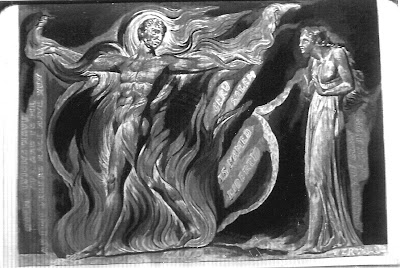 3.
3.
Pray
We can be healthily skeptical of people who greet one another and ask, "is that Michael or Gabriel?" As if they commonly appeared in bookstores. If anybody can be believed that Gabriel sat for his portrait, as Blake is said to have told Thomas Phillips while having his portrait done, Blake might: "he waved his hands; the roof of my study opened; he ascended into heaven; he stood in the sun, and beckoning to me, moved the universe (Davis, 121). Among many monastic devotees of the inner world, Blake is alone. Sake of argument grants that his chief hero, Los the imagination, is tarnished as he enters the doors of perception. It is Blake's psychological allegory of the Fall.
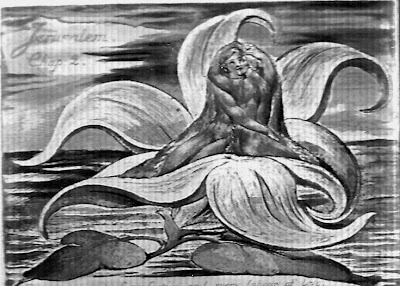
So Blake found a
Way Into the Flowering Heart where you can live every day, or just those days when you are
not high. Be temporal and eternal.
Blake turns over the cart, thinks what has been done to the essence of truth is its assassin. Blake turns angels into devils to say that. If there's a hero of literature it's Blake. He takes the top of the head of the reader off partly because his extreme thought sometimes derives from even extremer, say Swedenborg, but mostly because Blake does not suffer fools. Support for many radical views found in his politics and poetics prove Blake a Christian the same way as Edwin Muir, translator of Kafka. After every devotion to Nietzsche and psychological difficulties, terrors of psycho-analysis, which he says stemmed from his fundamentalist upbringing and a forced religious experience when he was 14, he says, "I realized, that quite without knowing it, I was a Christian." (
An Autobiography. Seabury, 1968. 168, 247).
Blake forgets to be corrosive when he and his wife kneel and pray to the Holy Spirit for inspiration. (
William Blake. A New Kind of Man. Michael Davis. 1977, 155). Imagine what critics do when he reincarnates Milton, as outside the rationalist experience as Milton's insistence that the Holy Ghost dictated
Paradise Lost to him each night in entirety, which he told to his daughter the next day. So much of what passes for understanding by critics is amoral black and white. They are the very fundamentalists they themselves should flee. The artistic case has even more contradiction than the general human. To withstand the contradictions of Blake's opposite states without compromising the portrait he gives of himself as a Christian is often too much for critical funds. They must make him fit their idea of rationality and art,
which they have been doing anyway everywhere, completely absurd.
Prophet
Talk about straining out a gnat to swallow a camel! A lot of Blake's biography derives from Tatham whose reports give Blake a pietistic tincture, reporting practices of prayer that indicate he is the opposite of a free thinker. The same Tatham burned and disposed much of Blake's literary remains. It did not meet his approval. Just so, critics continue to seek a Blake they can comfortably digest, but his rampant evangelicism is not to their taste. Blake is a prophet in the biblical vein. He says and does things as unprecedented as the biblical prophets.
A comparison for
fraktur art and the way into the flowering heart in Blake stems not only from the art, but from the faith. As Stoudt says (
Pennsylvania German Folk Art, 24) it is only when a species of disbelief took hold in the minds of the Pennsylvania faithful, what he calls liberalism, that their art failed. And that art under digital magnification continues to amaze, as we hope to show. So what of their faith? There are so many ex-fundamentalists with delicate sensibilities, but good upbringings, that many readers of Blake and Fraktur are impaired by their previous lives. Without naming names of our contemporary literary peers (at least not yet), this case affects Blake, who is celebrated for his "corrosive" art in the
Marriage of Heaven and Hell, but only because critics pretend Blake is not a Christian.
 What the Redeemed Do
Blake is rather more than merely a Christian in name. He is one in his art, poetry and life, easiest to see in the art maybe, but in his poetry it is more dramatic. Critics gloss over these passages even as they explain them away, as Yeats does in his Introduction (
Poems of William Blake), but there it still is, for example in
Jerusalem where Blake invites, "I hope the reader will be with me wholly one in Jesus our Lord who is the God and Lord to whom the Ancients look'd and saw his day afar off with trembling & amazement." That alone goes further than allowed by the modern editor. Sorry Blake, "that isn't quite right for us." But Blake published himself and said what he would. Of course the subjects of his art are wholly biblical in every way,
Job, notwithstanding the erosion that occurs from disinformation. If it sounds like this is a conspiracy to deny Blake his own faith, it is his critics who have denied their own.
In his personal life the reports of Blake and his wife are supernaturally scandalous, which information comes from Linnell. Of the application of fundamentalist attitudes to the poets however, witness the psychological dissection of
Hopkins, who if he were what anthropologists used to call a "salvage" would have his own museum of reconstructions. Here he is a degenerate, there a fascist, any and all things where the good is remade into stereotypical evil that gets young
peppery guys published. The essence of the fundamentalist attitude is celebrated "outward ceremony," Wayne Dwyer selling his 20,000 books and moving to Maui to follow the Tao, just what Oprah would like, an easy grasp of the profound. Blake says that the eternal body of man is the imagination and that to be a Christian is to be an artist, a poet/painter/musician/architect, and that that is the only preoccupation of the mind, gained over life and work, not in ease. Then we can know who the Christians are, not that art makes them so, it is just
what the redeemed do.

Eternity Within
Another way to demolish art and artist, Blake in particular, is to acknowledge his Christ, but claim him simply confused. Do not forget what they did to Orpheus, tore him limb from limb. So they call Blake's "a system so arcane, so embroiled in its own solipsistic mythology, that it is a resounding
failure." "I will fit my small mind into his" should be the quest of these seekers of eternity in their dreams. Blake and his companions Milton and Hopkins lived it in the day. "Are you eternal?" You could ask the critics this, but they won't like it. George Richmond went walking with Blake, "feeling as if he were walking with the prophet Isaiah" (Davis, 154).
The smart people of the world want to ask, "was Jesus Christ a Christian?" But "all men are in eternity... though it appears Without,
it is Within in your Imagination of which this World of Mortality is but a Shadow." So get on with your undressing. Should you never read to perceive another word of the flowering heart, know that this
inwendigkeit is also the way peasant ancestors put into their art.
4. The Most Profound Speakers of English
We are flat out of examples of the One Man who keeps cropping up in Blake's visions. When you wrap your arms around a man you are going to get a multitudinious contradiction. Adam Kadmon is not real!
Billy Blake is going to be imperfect. Our secularists have gotten way too comfortable in shrinking a Christian down to a buffoon with the morals and prejudices of corruption. There is no need to compare him with an animal. The dog is noble. The wolf is noble. It is the man.
As we see Christians in art as w riters, they are latitudinarians not Luthers. Blake says Luther kept whores. How modern of him. Christians are like
 Jonathan
Swift. When his yahoo rains refuse down upon the narrator standing under a tree, that is what a christian would say in art. The broadness of a christian cannot be managed. Donne was a christian when he wrote the Songs and Sonnets. Later he says, "so they would read me throughout, and look upon me altogether...let all the world know all the sins of my youth, and of mine age too, and I would not doubt but God should receive more glory, and the world more benefit, than if I had never sinned ("On Prayer, Repentance, and the Mercy of God." Sermons. Ed by Edmund Fuller, 1964, 160).
So many of the most profound speakers of English own that language of faith. The only recourse of their enemy, another Christian idea, is to make it seem like there are hardly any Christian poets in English. There is hardly anything else. Wallace Stevens was a Christian! A forgiving bunch, they allow Dimmesdale back in the pulpit after a suitable time because "the gift of God is without repentence." Blake's specie of Christian, and remember that his works were burned by just those same specie, is still a page in Marriage where Palmer says "I think the whole page...would at once exclude the work from every drawing room table in England" (The Stranger From Paradise, 409).
Who comes off worse in the pantheon of life, David, Solomon or Blake? It is hard to put asunder what their beliefs join together. It doesn't matter what outlandish thing Blake may have said or done; at root he belongs. Christians say, "by their fruits you will know them." Their chief supporting actor, Paul, began his career by making them betray themselves under threat of death. That was before, not after? There are all these escape clauses. Kill the body but don't mess the mind.
We Kneel Down and Pray
Linnell said he "found it hard to get the great mystic into their little thimble" (
Stranger, 409). George Richmond, the youngest of the Ancients [a group who gathered respectfully around Blake at his end], an aspiring artist, in all naivete asked Blake one day what to do when: a) he wanted to know the will of God b) wanted to know whether to take care of his aged mother or fight in the French resistance or c) what to do when he was out of artistic gas: "To his astonishment, Blake turned to his wife suddenly and said: "It is just so with us, is it not, for weeks together, when the visions forsake us? What do we do then, Kate?" "We kneel down and pray, Mr. Blake" (
Stranger, 403).
Dissenters speak the language of Enthusiasm, Bentley says, (365) citing Linnell, "The mind that rejects the true Prophet...generally follows the Beast also for the Beast & False-Prophet are always found together." Such notions of the prophetic are intimately biblical. They mean that "Blake claimed the possession of some powers only in a greater degree that
all men possessed and which they undervalued in themselves & lost through love of sordid pursuits--pride, vanity, & the unrighteous mammon" (367). Yeats would come right out of his grave to get these powers. Think of the comfort that would give theosophists who in their work merely imitate the Christian! Try as he may Yeats cannot. We will visit him there soon. Stay tuned.Try as he would, to get "the power,"Yeats invented visions out of intellect. If you yourself see fleas in the spirit, as Blake, that is, originally perceive the unknown, be democratic and share the wealth with the poor!
Infallibility
All men are equal, what! Tatham, burned the plates (
Blake merely gouged them). This very tainted source, says when Blake thought he had the Seeing fixed "before his mind's Eye...that while he copied the vision (as he called it) upon his plate or canvas, he could not Err; & that error & defect could only arise from the departure or inaccurate delineation of this unsubstantial scene" (371). Blake's claim to infallibility in something nobody can confirm smacks of Enthusiasm. Enthusiasts must be taken for what they are. Bentley says "the testimony about Blake's madness among contemporaries who did not know him is close to unanimous" (379). Among those who knew him, at least prior to 1820, the case was only somewhat better.
Bentley gives an understanding that the grounds of his mad reputation were based on the observation that Blake's spiritual world was in form disconcertingly like the material outer world (380). Would we expect it to be different? Such "resemblances" (see Wallace Stevens'
Necessary Angel, "The Figure of the Youth as a Virile Poet," 61) are necessary to recognize the form being seen. It is always the case in these philosophies, occult or other, that reflections of order occur for the purpose of recognition, that the Other is not hiding so much as hid by the viewer's blindness, as Linnell means about "sordid pursuits" that blind.
Draw Aside the Curtain
Evidence that after 1820 Blake became serene occurs in his Virgil woodcuts, his taking a glass of porter (393) and the conviviality of his circle, especially Edward Calvert, Samuel Palmer, George Richmond and Frederick Tatham (401). The woodcuts receive approval from all comers. Samuel Palmer, at the time said, "There is in all such a mystic and dreamy glimmer as penetrates and kindles the inmost soul, and gives complete and unreserved delight, unlike the gaudy daylight of this world. They are like all that wonderful artist's works the drawing aside of the fleshly curtain" (392). This flesh curtain is much at issue with Blake.
Never take what others say somebody said without compelling reason. That means what Varley or Crabb Robinson say Blake said is not much admissible as fact. Quote what Blake wrote. But Linnell is worthier. Is that because Varley is an astrologer and says Blake has Mercury square Mars which gives depth of mind! What about Blake's seances with the Visionary Heads? Blake, starved for company was adopted by a handful of young men who came to his house after 1820 and cultivated him. He told them he could see into the you know what, so Varley got him at a table and Blake drew heads

like Edward I, etc. Then Blake drew the visionary head of a flea. That's the high art of spoof. Varley's too serious and is being mocked with a straight face. He says Blake said the flea was originally created large but had to be shrunk because it was too great a predator. It's a good thing Donne didn't hear about it! The sensationalisms of literature should be read as fiction. Shall Gulliver be turned into Hakluyt? He has, but look at the Colonials! Blake knew who Christians were, not that art made them, it is
what the redeemed do. That was the
inwendigkeit Anabaptists put in their art.
If you are new to Blake go
here.
Postscript
"Nearly all of us have felt, at least in childhood, that if we imagine that a thing is so, it therefore either is so or can be made to become so. All of us have to learn that this almost never happens, or happens only in very limited ways; but the visionary, like the child, continues to believe that it always ought to happen. We are so possessed with the idea of the duty of acceptance that we are inclined to forget our mental birthright, and prudent and sensible people encourage us in this. This is why Blake is so full of aphorisms like "If the fool would persist in his folly he would become wise." Such wisdom is based on the fact that imagination creates reality, and as desire is a part of imagination, the world we desire is more real than the world we passively accept" (Northrop Frye, Fearful Symmetry, 27).
I was studying Blake and made a living off his Tyger. It produced four paychecks. Thinking to calve a Blake comic, I got copies of the slides of Jerusalem before cellphones, but the cost of production outran. They are reproduced here in black and white. Imagine Blake street-bound in newsprint of lurid colors! Ignorance is a kind of grace and Enthusiasm its naivete.
10. Mystical Heart Diagrams of Paul Kaym
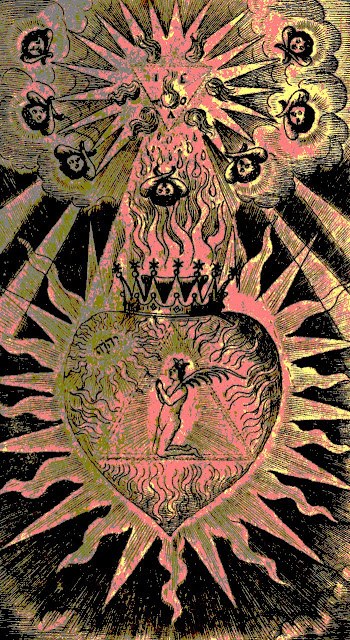
Crisp repoductions at
Lexicon here
The mystical heart diagrams of Paul Kaym @ Levity
The
Helleleuchtender Hertzens-Spiegel, Amsterdam and Gdansk,
Heinrich Betkius,1680, is thought have been been compiled and edited by
Paul Kaym from writings of Abraham von Franckenberg . The title page
indicates that it is written following the deep principles and powerful
doctrine of the highly illumined Johannes Tauler (the 14th century
German mystic), however, it owes much to the mystical philosophy of
Jakob Boehme. Paul Kaym had written to Boehme in 1620 asking him about
the 'end of time', and was answered in letters 8 and 11 of Boehme's,
later published,
Epistles. Kaym also wrote learned commentaries
on the Song of Songs and the Book of Revelation. He was a chiliast,
believing in an immanent end of the world, though he faced this calmly.
He saw no place for the organised Church and the rituals of religion in
the quest for God, believing that inward illumination was the only basis
for spiritual growth. Thus he believed in internal absolution, inward
Baptism, and inner union with the divine.
The
Helleleuchtender Hertzens-Spiegel, was a popular work, in
which Kaym leads us upon a spiritual journey of the human heart and the
obstacles it meets on its quest for spiritual enlightenment. The series
of sixteen images were most likely engraved by Nicolaus Häublin, who
illustrated a number of works for the German followers of Jakob Boehme.
 The Mystical Heart Diagrams of Paul Kaym @ Jacob boehme online
Paul
Kaym was a 17th Century eschatologist who wrote to JB in the summer of
1620, asking the Theosopher to assess two treatises he had written on
end-time prophecy. Boehme responded in two letters (numbers 4 and 5 in
Collection 1 of THE EPISTLES OF JACOB BOEHME) which Kaym published as OF THE END TIMES.
The
following are from a 1705 Amsterdam edition which includes only the
first 14 diagrams. Nos. XV and XVI are taken from adern facsimi
Brightly
illuminating Hertzens mirror: by means of a threefold presentation ...,
I. The Erknnnis, II. The exercise, and then III. The
secret of true godliness, that is, the whole act, Krafft and Hertzens
theologia ... with highly valuable Kupffer figures ..., including a
short-fisted yet complete prayer booklet, or devotional spear
by Wehrd, N. of ; Tauler, Johannes, ca. 1300-1361
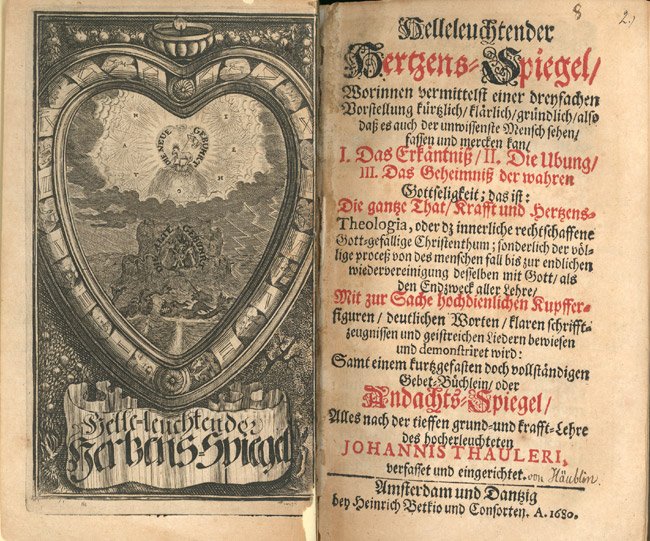

11. Pennsylvania Dutch Paradise
There are glimpses of American Indian notions of natural relation in the Pennsylvania Dutch sectarian Mennonite view of the world. Whether this can be proved from Mennonite words remains to be seen, but in their art we take as a given that it is already proved. From habit we cite three current works:
Ellen J. Gehret. This is the Way I Pass My Time, on show towel decorations,
Mary Jane Lederach Hershey. This Teaching I Present: Fraktur from the Skippack and Salford Mennonite Meetinghouse Schools.
Monroe H. Fabian. The Pennsylvania-German Decorated Chest.
Fraktur is a species of language flower assumed impossible, "...one basic fact must be underscored in studying these documents--the illumination was auxiliary to the text" (Weiser, "Piety and Protocol in Folk Art," 1). Such divorces need understanding. We want a closer relation of illustration and text.
Fraktur occurs in baptismal certificates called Taufschien, mostly printed, and freehand letters of reward and instruction, vorschrift, given to children. Until Hershey's Teaching (2003) there were few good reproductions. In a similar manner Blake's watercolors were hidden from public eye until the Princeton editions and the Blake Archive, although inferior reproductions existed. The essentially different genres of Taufschien and vorschrift, with the division of art from text, also mirror the divided demographics of the Pennsylvania German, 90% "churched" so called, Lutheran and Reformed, 10% Mennonite and Anabaptist. The "churched" have assumed proprietary status over the whole by their majority status, but are often outweighed by the social/political acts of the Mennonites. This sibling rivalry impacts all discussion. There are yet no online illuminated fraktur as there are with Blake.
Pennsylvania Fraktur art taught the alphabet to children, but when the actual letter strokes mimic the same strokes in the designs of flowers in the composition, this teaching becomes a kind of Calligrammes or a species of a hand drawn vispo, a flower of the hand and mind. Letters, alphabets, numerals, the colors and shapes in Plate 60 of Hershey's This Teaching, "Ihr Kinder Wolt ihr Lieben," ("O Children Who Are Loving") are woven to attract the child, now the adult, to contemplate the text with the art. This particular design is attributed to Jacob Gottschall (1793). The text, "O Children" is a hymn of Christopher Dock's, appropriately addressed to children, he a schoolteacher. At least among Mennonites fraktur was child art, designed for children, sometimes executed by children, colors and floral designs intended for the child's eye. How could it be high art, made by teachers and their students? It is folk art, famously so, but the involvement of children parallels Blake who is our literary schoolmaster. We paint the drawing with words.
A vine, a "stem" of tulips germinates from a globe/seed in the right hand corner, spreads up and to the left. Another bloom of this "plant," slightly unconnected and larger, blooms down from the top left, as though rooted in air, coextensive, but separate from the vine. This second larger bloom mimics the colors and shapes of the capitals of the title, Ihr Kinder in rose, blue and gold stripes, as though the letters were flowers or the flowers letters.The upstroke of the blue I combines with the down stroke of the rose h, making three letters out of two, which elision seems designed. The larger blooms have smaller dark stems, air borne, unrooted. A current of air lifts through the "letter petal" leaves, from right to left. It "blooms" in two large four-chambered blossoms, penetrated by segments of the unattached vine through each center of the four chambers (circles) of the flower, covered by a cross hatched red and gold diamond, Hershey's "checkerboard."
so ubt was freude worth...
Erquicken Hertz und muth
[The practice of joy...
quickens hearts and minds.]
Several phonetic cognates sound like English.The immediate short lines and rhymes are not felt in translation.This verse is not a slogan from twentieth century wars. The vine that springs from the seed at the lower right flows across the top of the page, which seed, translated, says, "Be with us, on all our ways / Dear God with thy blessing," which blessing, rises in the vine. The title words Ihr Kinder, underlined in gold, resemble the block style of Dock's fraktur, intersect the center of the page, divide the text below from its flower above, as if a flower of the text rises from the word garden. Language flowers teach the children to identify petal letters. The writing of the text below occurs in thirteen long cursive lines, its stanzas identified only by numerals 1 to 5, set in a hand so small the students must have known the hymn by heart. A child art, the colors, floral designs intend to attract the eye.
12. Language In Voices Out
Drops
Words are an image of every thought,
sound and sense, taste and color felt,
that swim in an ocean that resembles itself,
drawn up in air to eye and ear
that evaporate and fall from sky.
Seen as drops that were no such at all,
gathered in buckets, these drops make words.
“What is your aim in Philosophy?”
“To show the fly the way out of the fly-bottle” (Philosophical Investigations) – Wittgenstein
"Wittgenstein thought that the pursuit of philosophy in its traditional sense is pointless. Philosophers who scoured far and wide for a structured logical form applicable to everything were deluded and wasting their time, much like a fly who constantly tries to escape a transparent bottle by banging against the side. Wittgenstein saw it as his job to show these tenacious philosophers out of the top of the fly-bottle and to see philosophy for what it really is – a futile attempt to find an all-encompassing logical form of thought behind the mess that is ordinary language…"
Thought is the simultaneity of memory, reality, fantasy, being.
There is a lot said of the two voices In and Out. Inner and outer, the most simple saying, like language cannot simultaneously express wave and particle motion. If the wave is both so is the being. Poets want to hallow thought by resort to "a new language," asserted of Beissel's mysticism (by Bach) as much as of Boehme. Poets want to speak revelations like prophets on their own terms. Steve McCaffery and Karen Mac Cormack (end of the interview) want their voices to be an "idea, already implicit in Aristotle’s description of the two voices (articulate and inarticulate) [and] obtains almost a pataphysical excellence!" Pataphysical means imaginary, an imaginary solution to an imaginary problem. On the same page Mac Cormack gets pataphysical, says "Voice is a tangled mythogeme," that "poetry’s primal scene as that of inspiration involves at its base a fundamental “other” voice, a voice speaking through one. This image of the poet as a passive, possessed mouthpiece of an alien voice runs from Plato’s Ion through to Jack Spicer’s poetics of dictation."
Speaking through is not novel to those who do. Calling it alien is more theater than belief. It's not alien if endemic and indigenous, meaning from within the speaker's life. Indigenous means the same but more of community or ethos, Hopi or the Pennsylvania Dutch. WhateverWalt Whitman says comes from his own peculiarly driven mind even if spoken with the voice of the Upanishads. A new language does not imply new ideas, facts. Some writers, Barthes, Agamben see the alien voice as the voice of death, "the originary place of negativity" and "...language is a negativity, the unsayable and the ungraspable" (Agamben) and cannot but be negativity unless it never existed. The thought goes, then, "only if language no longer refers to any voice...is it possible for man to experience a language that is not marked by negativity and death" (Dillon, Politics of Security, 115). But the voiceless verb, the silence of unknowing that passes as world class originality to the rest seems suicidal.
Is language pure thought? There is no language of protons. The universe is thought, but it is not language. Thought itself is not language. The last paragraph of the interview "distinguishes an animal voice (a voice of sonic continuum) from a human voice (a voice of sonic articulation).... The animal voice, Hegel claims, is pure sound, empty and grounded in negativity... every animal finds its voice in its violent death; it expresses itself as a removed self.” You think Hegel ever left his house? Mayhap every animal finds its voice in praise of life. Sometimes the man speaks with animal voice, body voice, as with moans, cries, but the man is the one removed. Assuming to be proved that he is removed, "By intercepting this animal voice of death and subjecting it to articulation, human language, he says, emerges with two decisive characteristics: (1) it retains within it the voice of death; (2) it becomes the voice of consciousness thereby converting negativity into being. To me signals a fundamentally poetic quality in Hegel’s thinking, establishing as it does its mythogeme of “voice” on the codification of vowel and consonant as respectively animal and human." (46). Too many vowels, drugs, disease, or disaffections?
The death of the author (Barthes) in all this is simple speech. To speak as a bear, fly like a bird, leap like a cat is voice without language or sound. In voice as action these philosophers could write a bestiary of themselves. A bestiary of vowels. It comes down neither to voice or language but to breath. Everything that has breath. Comic cosmic bestiaries pronounce linguists and philosophers slandering the animal to justify a human malaise.However the poet is passively speaking, not in speaking the voice of death, is transfiguring life.
But negativity so converted reverses life. The notion that human language is the voice of death, because derived from the animal symbolizes how species' extinction translates from the commercial into the philosophical, as if Hegel never left his house to walk in the woods. Beyond carnivores, it is not the voice of death in the song bird or elk, it is the voice of the joy of life. Somewhere it says that everything that has breath praises. This is being posted on the phone poles of Nashville. Praise is the song of animal speech, the tongue of life not death.
The reason I like this IsReads pic, a little white spot you can barely see, dwarfed by the city of Chicago, is because it is a picture of when everything will praise, written then in the bone so large, as it is now is in the under bone, a parallel dimension called the kingdom of God, big then as Chicago is now bigger than it.
The Medium of Thought
What are the languages of the in and out? There is no language of In. To call thought "language" is a metaphor used only because there is no language of thought. Thought is cast into language by speech, translated by voice when speech occurs. This translation is magnanimous. It assumes the end of the beginning. I speak therefore I think. Thought is not languaged. Its exploration must occur between people after it is translated to language when the presumption occurs that it is language. It is a glaring assumption that I speak what I think. The medium of thought is the image.
Postulate
What good is work if the life cannot live? Poets fail in their public and private thoughts. We say life is a work. We say public achievement, action imitated and celebrated, may burn. We say the nature of a poet's death is important as his birth. Then we know what we control. Death is not desired, not suicide or any of diseases, strokes, sicknesses. What is left at the end of a year depends on what theme we follow. All themes merge in each other in memory and thought. Who died young, who of sickness, who of addiction, who was alienated, lost love, found ignominy, prison? The mishaps of necessity gain sympathy.
Suffering makes the soul, binding the book, mistake and limitation art. Suffering is sympathetic when it appears Necessary. Put under stress, see what comes out. Art comes when the farmer's skin cracks. Surgeons do not suffer such defects, but all suffer choices. One is doctor, another a farmer is luck, maybe destined. Desperations escape, things turn on their head. Enough food in some places causes obesity . Too little is too much, the atmosphere, autism is up. If only were the throat of the world unloosed. It is of poets this illumination comes. To find a context for our lives we judge theirs.
Words Themselves
Imagine words themselves, spoken the last moment before waking as a cue, to figure out what?
Navajo matriarchy? The imagination of kinship. The phrase occurs in Karl Magnuson's, The World from Within, in an article "The Utopian Imagination of Aboriginalism," in "Virtual Kinship, Real Estate, and Diaspora Formation" and most importantly in the Poetics of the Feminine and that's it.
There is increasing consciousness that kinship lasts materially beyond death. It is said that you know your parents after their deaths and if parents then entire genomes. Is this another case where the thing exists in a way not known before, as is said of consciousness or is it revisting the guest-host codes, reverence of ancestors in patriarchy? Ken Morrison's The Solidarity of Kin (2002), "Toward a History of Intimate Encounters" traces the offer of kinship to the other.
Does it take the inquiry into less aware notions of mythogeme, of notions of Bataille's death of myth which is really birth of anti-myth, new myth?
The good news is some interesting writers are attracted here, Steve McCaffery's, Prior to meaning: the protosemantic and poetics , who applies Prigogine's physics to poetry, just what Prigogine wanted to do.
13. the way out of the flowering heart
"Wittgenstein thought that the pursuit of philosophy in its traditional sense is pointless. Philosophers who scoured far and wide for a structured logical form applicable to everything were deluded and wasting their time, much like a fly who constantly tries to escape a transparent bottle by banging against the side. Wittgenstein saw it as his job to show these tenacious philosophers out of the top of the fly-bottle and to see philosophy for what it really is – a futile attempt to find an all-encompassing logical form of thought behind the mess that is ordinary language…"
Thought is the simultaneity of memory, reality, fantasy, being.
The simplest said of the two voices
In and
Out is that as language cannot simultaneously express wave
and particle motion, the wave being both, so is being. Poets want to hallow thought to "a new language," asserted of Beissel's mysticism (by Bach) as much as of Boehme, as much as anyone. Poets want to speak revelations like prophets on their own terms.
Steve
McCaffery and Karen Mac Cormack (end of the interview, Université de Orléans, France “An Interview with Karen Mac Cormack and Steve McCaffery” (by Antoine Cazé), 28–47) want their voices to be an "idea, already implicit in Aristotle’s description of the two voices (articulate and inarticulate," [Out and In] that "obtains almost a pataphysical excellence!" There of course is no pataphysical excellence. Pataphysical means a joke, an imaginary solution to an imaginary problem. On the same page Mac Cormack gets pataphysical when she says "Voice is a tangled mythogeme," that "poetry’s primal scene as that of inspiration involves at its base a fundamental “other” voice, a voice speaking through one. This image of
the poet as a passive, possessed mouthpiece of an alien voice runs from Plato’s
Ion through to Jack Spicer’s poetics of dictation."
There is no language of thought.
Speaking through is not novel to those who do. Calling it
alien is more theater than belief. It's not alien if endemic and indigenous from within the speaker's life. Indigenous means of community or ethos, Hopi, Pennsylvania Dutch. Whatever Walt Whitman says comes from his own peculiar mind even if spoken with the reference to the Upanishads. Secondly, a new language does not imply new ideas, facts. Some writers, Barthes, Agamben see
the alien voice as the voice of death, "the originary place of negativity" that "...language is a negativity, the unsayable and the ungraspable" (Agamben) and cannot but be negativity unless it never existed. Here they equivocate language for thought, which is unsayable. The argument goes, then, "only if language no longer refers to any voice...is it possible for man to experience a language that is not marked by negativity and death" (Dillon,
Politics of Security, 115). But the voiceless verb, the silence of unknowing that passes as world class originality, is not language. There is no language of thought.
There is no
language of protons. If the universe is thought, it is not language. The last paragraph of the interview "distinguishes an animal voice (a voice of sonic continuum) from a human voice (a voice of sonic articulation).... The animal voice, Hegel claims, is pure sound, empty and grounded in negativity... every animal finds its voice in its violent death; it expresses itself as a
removed self.” Obviously Hegel never left his house if he said that. Every animal finds its voice, not in death, but in praise of life.
Sometimes a man speaks with animal voice, body voice, as with moans, cries, but the man is the one removed from the event. Assuming to be proved that he is removed, "intercepting this animal voice of death and subjecting it to articulation, human language, he says, emerges with two decisive characteristics: (1) it retains within it the voice of death; (2) it becomes the voice of consciousness thereby
converting negativity into being to me signals a fundamentally poetic quality in Hegel’s thinking, establishing as it does its mythogeme of “voice” on the codification of vowel and consonant as respectively animal and human." (46).
Too many vowels, drugs, diseases, disaffections.
Voice as action is breath.
The death of the author (Barthes) in all this is simple speech. In
voice as action these philosophers could write a bestiary of themselves. A
bestiary of vowels. To speak as a bear, fly like a bird, leap like a cat, if voice is action, is voice without language or sound. It comes down neither to voice or language but to breath. Everything that has breath.
Comic cosmic bestiaries pronounce judgment on linguists and philosophers for slandering the animal to justify their human malaise. However the poet is passively speaking, not in speaking the voice of death, is transfiguring life.
But negativity so converted reverses life. The notion that human language is the voice of death, because derived from the animal symbolizes how far species' extinction translates from the commercial into the philosophical, as if Hegel never walked in the woods.
Beyond carnivores, it is not the voice of death in the song bird or elk, it is the voice of the joy of life. Somewhere it says that everything that has breath praises. This is being posted on the phone poles of Nashville and in Chicago. Praise is the song of animal speech,
the tongue of life, not death.
The little white spot you can barely see, this
IsReads pic dwarfed by the city of Chicago is a picture of praises, written in the bone so large, as it is now under the bone, a parallel dimension, bigger than Chicago.(now defunct except in this pic below.
The Medium of Thought
What are the languages of in and out?
There is no language of In. To call thought "language" is a metaphor used only because there is no language of thought. There is no language of anything except language. Thought is cast into language by speech, translated by voice when speech occurs. They used to call this
analysis by synthesis. This translation is magnanimous. It assumes the end of the beginning. I speak therefore I think, but
thought is not languaged. Its exploration must occur between people after it is translated to language when the presumption occurs that it is language. It is a glaring assumption that I speak what I think. The medium of thought is the image not the words, the loaf of bread, the picture of the loaf of bread, but not the word, bread.
Poets fail in their public and private thoughts. We say life is a work. What good is the work if the life cannot live? We say public achievement, action imitated and celebrated, may burn. We say the nature of a poet's death is important as his birth. Then we know what we control. Death is not desired, nor suicide nor any of the diseases, strokes, sicknesses. What is left at the end of a year depends on what theme we follow. All themes merge in each other in memory and thought. Who died young, who of sickness, who of addiction, who was alienated, lost love, found ignominy, prison? The mishaps of necessity gain sympathy. Suffering makes the soul, binding the book, mistake and limitation, art. Suffering is sympathetic when it appears. Put under stress, see what comes out. Art comes out when the farmer's skin cracks. Surgeons do not suffer such defects. But all suffer choices. That one is a doctor another a farmer is luck, maybe destined. Margaret Thatcher however said that after beliefs, thoughts, words, deeds form character, that then character forms destiny. Desperations escape, things turn on their head. Enough food in some places causes obesity. Too little is too much, the atmosphere, autism is up. If only the
throat of the world were unloosed as it is of poets from whom this illumination comes. To find a context for our lives we judge theirs.
Words Themselves
"The imagination of kinship." Kinship lasts beyond death. Imagine words themselves, spoken the last moment before waking as a cue, but to figure out what? Navajo matriarchy? The phrase occurs in Karl Magnuson's, The World from Within, in an article "The Utopian Imagination of Aboriginalism," in "Virtual Kinship, Real Estate, and Diaspora Formation," and most importantly in the Poetics of the Feminine and that's it. You know your parents after their deaths and if parents then entire genomes. They exist then in a way not known before, as is said of consciousness. Revisting guest-host codes, reverence of ancestors in patriarchy? Too much dogma. Inquiry into less aware notions of mythogeme, notions of Bataille's death of myth is really anti-myth myth. Some interesting writers attach here, Steve McCaffery's, Prior to meaning: the protosemantic and poetics, who applies Prigogine's physics to poetry, just what Prigogine wanted to do.
Drops
Words are an image of every thought,
sound, sense, taste and color felt,
that swim in an ocean that resembles itself,
drawn up in air to eye and ear
which evaporate and fall from sky.
Seen as drops that were no drops at all,
gathered in buckets, these drops make words.
There is no
language of protons. The universe is thought,
not language. Thought is not language. Is language thought? The last
paragraph of the interview "distinguishes an animal voice (a voice of
sonic continuum) from a human voice (a voice of sonic articulation)....
The animal voice, Hegel claims, is pure sound, empty and grounded in
negativity... every animal finds its voice in its violent death; it
expresses itself as a
removed self.” How could Hegel ever have
left his house to say this? Every animal finds its voice in praise of
life. Sometimes the man speaks with animal voice, body voice, as with
moans, cries, but the man is the one removed from the natural. Assuming
to be proved that he is removed, "By intercepting this animal voice of
death and subjecting it to articulation, human language, he [Hegel]
says, emerges with two decisive characteristics: (1) it retains within
it the voice of death; (2) it becomes the voice of consciousness thereby
converting negativity into being. To me signals a fundamentally
poetic quality in Hegel’s thinking, establishing as it does its
mythogeme of “voice” on the codification of vowel and consonant as
respectively animal and human." (46). Too many vowels, drugs, disease,
or disaffections?
There is a lot said of the two voices of the In and Out, the simplest being that language cannot simultaneously express wave
and particle motion. If the wave is both so is thought. Poets want to hallow "a new language," asserted of Beissel's mysticism (by Bach) as much as of Boehme. Poets want to speak revelations like prophets. Steve
McCaffery and Karen Mac Cormack (end of the interview) want their voices to be an "idea, already implicit in Aristotle’s description of the two voices (articulate and inarticulate) [which] obtains almost a pataphysical excellence!" Pataphysical means imaginary, an imaginary solution to an imaginary problem. Language and thought are one of these. On the same page Mac Cormack gets pataphysical, says "Voice is a tangled mythogeme," and "poetry’s primal scene as that of inspiration involves at its base a fundamental
“other” voice, a voice speaking through one. This image of
the poet as a passive, possessed mouthpiece of an alien voice runs from Plato’s
Ion through to Jack Spicer’s poetics of dictation."
These writers mean by alien any heterology requiring a breaking apart, part and parcel of the new world of strangelets meant to make Earth into a neutron star. No Bataille, Heidegger, Derrida and Nietzsche do not reveal their plans in this. Peryaps (sic) they do not know, if they can be allowed this ignorance, since philosophy with science has been and is so directed by the alien heterology itself that posits a world where only the inorganic will hold sway, if inorganic means spirit. I don't know it it does. By this light the breaking of dimensions underway at CERN with induce the greatest modern act of deconstruction, the end of the world. No less that Hawking believes a vacuum to such suck. Any consideration of these ideas must therefore be lardered with neologism, solecisms, and outright mockeries of these notions, even while acknowledging what went before was mere preparation for this grand synthesis. Don't you want a whole earth. The Hegelian model still prevails until it is consumed. This of course all assumes, and won't mind saying so, the Messiah will not dash them to pieces, even as they know He will, but it won't change them after they have absorbed the beast into themselves. Then it will be true that that the beast will cry out with the language of negativity. At this moment however all the beasts are full of praise.
Speaking this way is not novel to those who do. Calling the other
alien however
is more theater than belief. It's not alien if it is endemic and indigenous, meaning from within the speaker's life. Indigenous means also of community and ethos, Hopi or Pennsylvania Dutch. Whatever Walt Whitman says comes from his own peculiarly driven mind even if is spoken with the voice of the Upanishads. A new language does not imply new ideas or facts, but some writers, Barthes, Agamben, see
the alien voice as the voice of death, "the originary place of negativity" and that "...language is a negativity, the unsayable and the ungraspable" (Agamben) and cannot but be negativity unless it never existed. The thought goes then that "only if language no longer refers to any voice...is it possible for man to experience a language that is not marked by negativity and death" (Dillon,
Politics of Security, 115). But the voiceless verb, the silence of unknowing that passes as world class originality is suicidal, because thought is Simultaneous Memory, Reality, Fantasy, Being.
Being, not being, language, thought, the death of the author (Barthes) in all this is simple speech. To speak as a bear, fly like a bird, leap like a cat is voice as action. These philosophers could write a bestiary of themselves. A bestiary of vowels comes down neither to voice or language but to breath. Everything that has breath. Comic cosmic bestiaries produced by linguists and philosophers slander the animal to justify human malaise. However the poet is passive in speaking, it is not in speaking the voice of death, but transfiguring life.
Negativity so converted reverses life. The notion that human language is the voice of death because derived from the animal symbolizes how species' extinction translates from the philosophical into the commercial, as if Hegel never walked in the woods.
Beyond carnivores, it is not the voice of death in the song bird or elk, it is the voice of life.
Everthing that has breath praises. This is being posted on the phone poles of Nashville. Praise is the song of animal speech.
The reason I like this
IsReads pic, a little white spot dwarfed by the city of Chicago, is it is a picture of the present. But everything will praise so large, as it is now small, a parallel dimension called the kingdom of God, big then as Chicago is now bigger than it.
The Medium of Thought

What are the languages of the in and out?
There is no language of In.
To call thought "language" is a metaphor used only because there is no
language of thought. Thought is cast into language by speech, translated
by voice when speech occurs. This translation is magnanimous. It
assumes the end of the beginning. I speak therefore I think.
Thought is not languaged.
Its exploration must occur between people after it is translated to
language when the presumption occurs that it is language. It is a
glaring assumption that I speak what I think. The medium of thought is
the image.
Postulate
What good is work if the life cannot live? Poets fail in their public and private thoughts. We say life is a work. We say public achievement, action imitated and celebrated, may burn. We say the nature of a poet's death is important as his birth. Then we know what we control. Death is not desired, not suicide or any of diseases, strokes, sicknesses. What is left at the end of a year depends on what theme we follow. All themes merge in each other in memory and thought. Who died young, who of sickness, who of addiction, who was alienated, lost love, found ignominy, prison? The mishaps of necessity gain sympathy.
Suffering makes the soul, binding the book, mistake and limitation art. Suffering is sympathetic when it appears Necessary. Put under stress, see what comes out. Art comes when the farmer's skin cracks. Surgeons do not suffer such defects, but all suffer choices. One is doctor, another, a farmer is luck, maybe destined. Desperations escape, things turn on their head. Enough food in some places causes obesity. Too little is too much, the atmosphere, autism is up. If only were the
throat of the world unloosed. It is of poets this illumination comes. To find a context for our lives we judge theirs.
Words Themselves
Imagine words themselves, spoken the last moment before waking as a cue, to figure out what?
Navajo matriarchy? The imagination of kinship. The phrase occurs in Karl Magnuson's, The World from Within, in an article "The Utopian Imagination of Aboriginalism," in "Virtual Kinship, Real Estate, and Diaspora Formation" and most importantly in the Poetics of the Feminine and that's it.
There is increasing consciousness that kinship lasts materially beyond death. It is said that you know your parents after their deaths and if parents then entire genomes. Is this another case where the thing exists in a way not known before, as is said of consciousness or is it revisting the guest-host codes, reverence of ancestors in patriarchy?Does it take the inquiry into less aware notions of mythogeme, of notions of Bataille's death of myth which is really birth of anti-myth, new myth? The good news is some interesting writers are attracted here, Steve McCaffery's, Prior to meaning: the protosemantic and poetics , who applies Prigogine's physics to poetry, just what Prigogine wanted to do.
This piece was subtitled
the alien voice, but it is not. Likewise in Human Botany there is a piece called
Alien Knowing and Unknowing, but it too is not and neither is the
Space Counterfeit Messiah alien of A Poetical Reading. The dramatic, romantic modern needs new language or old and more honest found to talk of the human.
“What is your aim in Philosophy?”
“To show the fly the way out of the fly-bottle” (
Philosophical Investigations) – Wittgenstein
"Wittgenstein thought
that the pursuit of philosophy in its traditional sense is pointless.
Philosophers who scoured far and wide for a structured logical form
applicable to everything were deluded and wasting their time, much like a
fly who constantly tries to escape a transparent bottle by banging
against the side. Wittgenstein saw it as his job to show these tenacious
philosophers out of the top of the fly-bottle and to see philosophy for
what it really is – a futile attempt to find an all-encompassing
logical form of thought behind the mess that is ordinary language…."
There
are two languages one of words, one of images, except that in a third
the words hide illusions of words in the first, and in the forth the
images are symbols of something else entirely.
Words are an image of every thought,
sound, taste and color felt.
That swim in an ocean that resembles itself,
drawn up in air to eye and ear
to evaporate and fall from sky.
Seen as drops what were none at all,
gathered in buckets, these drops make words.
14. Voice. The Way Out of The Flowering Heart: